Saturday, April 4, 2020

April 2020


Saving Monticello: The Newsletter
The latest about the book, author events, and more
Newsletter Editor - Marc Leepson

Volume XVII, Number 4                                                                                                                       April 1, 2020

The study of the past is a constantly evolving, never-ending journey of discovery.” – Eric Foner

IN MEMORIAM: I am deeply saddened to report that Harley Lewis, a great-grandniece of Uriah Levy and a grandniece of Jefferson M. Levy—and one of the last members of her generation of Levy descendants—died at her home in White Plains, New York, on March 24 at 94. My deepest condolences to Harley’s sons Richard, Jim, and Tom, and her brother Phillip, and to their families.

Harley was born on November 13, 1925, the daughter of Harold L. Lewis and Frances Levy Lewis, who was known as Fanny. Harley’s maternal grandfather was L. Napoleon Levy, Jefferson M. Levy’s brother. Her great-great grandmother—Uriah Levy’s mother, Rachel—is buried along Mulberry Row at Monticello after having died there in 1839, five years after Uriah purchased Monticello from James Turner Barclay.

Harley Lewis, circa 2011. Photo courtesy of Richard Lewis

According to her New York Times obituary, Harley graduated from Syracuse University in 1957, married Richard C. Lewis, and worked as a librarian in the Edgemont Public School system in Scarsdale, New York, and at Congregation Kol Ami in White Plains. Harley and Dick Lewis were very active in that congregation for many years. She served on its board, and was a founding member of the Westchester Coalition of Food Pantries & Soup Kitchens.

Harley was the keeper of much of her family’s Monticello history. When I started researching Saving Monticello in 1999, Dan Jordan, then the president of the Thomas Jefferson Foundation (which owns and operates Monticello), and Susan Stein, Monticello’s curator, spoke admiringly of Harley and strongly suggested that I contact her.

I visited Harley and Dick at their home in Westchester County and they couldn’t have been more kind, gracious, and welcoming. After feeding me lunch, Harley and I went through her extensive collection of family materials and she shared every one with me. Among many other things, she kindly gave me a copy of the unpublished memoir of her great grandfather, Jonas Levy, one of Uriah’s brothers. And she gave us permission to use two family photos in the book.  

Here’s one of them: a picture of Harley’s mother Frances sitting in the buggy with her sister Agnes, with their cousin Monroe Levy on the lawn at Monticello sometime in the 1890s.


Harley told me about her mother and father’s recollections of visiting Monticello in the 1930s—and the less-than-welcome reception they (and other family members) felt there. On at least one occasion, they were refused permission to visit Rachel Levy’s grave, which was hidden from public view behind a locked gate.

That situation didn’t substantially change until 1984 when Dan Jordan took over at the Foundation and began an effort to have the Levys’ role officially recognized at Monticello. The first step was refurbishing the Rachel Levy grave site and placing a plaque there honoring the family.
On June 7, 1985, Harley and Dick Lewis and other family members and guests took part in a commemorative ceremony there. Dan Jordan welcomed everyone, saying the occasion marked the beginning of the Foundation’s recognition of the Levys’ “good stewardship” of Monticello.

The highlight came when Harley Lewis unveiled a new plaque at her great-great grandmother’s newly refurbished grave site that concluded with the words: “At two crucial periods in the history of Monticello, the preservation efforts and stewardship of Uriah P. and Jefferson M. Levy successfully maintained the property for future generations.”

Harley faithfully read every issue of this newsletter and regularly emailed me with kind words after each one came out. Her last email arrived on March 3. In it, she wrote, “You always come up with fascinating bits of family history. It makes my day to receive this news. Don’t stop sleuthing.”
I won’t, Harley.

BETH ELOHIM: On a mid-March visit to Charleston, South Carolina, we had the chance to visit the historic Kahal Kadosh Beth Elohim Synagogue two weeks before the nation went into widespread quarantining. The majestic building in downtown Charleston, which dates from 1840, is the country’s second oldest synagogue and the oldest one in continuous use. The congregation, which started in 1749, is the fifth oldest in the U.S. behind:


Shearith Israel, which began in 1654 in New York City

Congregation Jeshuat Israel, founded in 1658 in Rhode Island; its Touro Synagogue, dedicated in          1763, is the nation’s oldest synagogue building

Mickve Israel in Savannah, founded in 1733

Mikveh Israel in Philadelphia in 1740

The Nunez, Machado, and Levy families—including Uriah P. Levy and Jefferson M. Levy—worshiped at Shearith Israel and Mickve and Mikveh Israel. Work on the latest restoration of the sanctuary at Beth Elohim had ended just days before we toured the place. Took these pics:


EVENTS: I had several events scheduled for April. They’ve been cancelled or postponed due to the coronavirus pandemic. Hope to have speaking events set up this fall.  
To check out my scheduled late 2020 events, go to the Events page on my website at http://bit.ly/Eventsandtalks

If you’d like to arrange an event for Saving Monticello, or for any of my other books, feel free to send me email at marcleepson@gmail.com  For info on my latest book, Ballad of the Green Beret, go to http://bit.ly/GreenBeretBook

GIFT IDEAS:  Want a personally autographed, brand-new paperback copy of Saving Monticello? Please e-mail me.  I also have a few as-new, unopened hardcover copies, along with a good selection of brand-new copies of my other books.

Tuesday, March 3, 2020

March 2020


Saving Monticello: The Newsletter
The latest about the book, author events, and more
Newsletter Editor - Marc Leepson

Volume XVII, Number 3                                           

March 1, 2020

The study of the past is a constantly evolving, never-ending journey of discovery.” – Eric Foner

NEW EDIFICE: Members of the Levy/Phillips/Nunez family have been associated with New York City’s Shearith Israel, the nation’s oldest Jewish congregation, since 1734. That’s the year that David Machado, who married Uriah Levy’s great grandmother, Zipporah Nunez, moved to New York from Savannah to become the temple’s Hazzan (Prayer Reader). 

As I noted in Saving Monticello, as Hazzan, The Reverend Machado, as he was known, had many duties, including granting licenses to inspect and kill cattle under Jewish dietary laws. He also conducted religious services and was responsible for reciting certain prayers.


Uriah Levy, who—when he wasn’t at sea or spending time at Monticello—lived in New York City from the 1820s until his death in 1862, was a member of the congregation. And his nephew, L. Napoleon Levy (Jefferson Levy’s brother), served as president of the Shearith Israel Congregation in the 1890s and early 1900s.

L.N. Levy, like his older brother Jefferson, was a New York City lawyer. In fact, the brothers became law and business partners. The younger Levy, who died at age 66 in 1921, headed the Congregation when the decision was made to build its fifth and current building on West 70th Street and Central Park West on an uptown plot of land that been a duck farm.


The noted New York City architect and city planner Arnold Brunner (1857-1925) designed the imposing neo-classical building. Louis Comfort Tiffany did the interior design work, including—naturally—the stained glass windows.

When it came time to lay the cornerstone for the new building, on May 20, 1896 (8 Sivan, 5656 on the Hebrew calendar), L. Napoleon Levy was given the honor. To mark the occasion, the Congregation presented him with an engraved trowel. A big thank you to Steve Lewis, a great-great grandnephew of Jefferson Levy, for sending me the terrific image of the trowel below.


The “fine new structure,” as the New York Journal and Advertiser put it, was dedicated, a year later, on May 19, 1897. Today, an engraved plaque on the ground floor recognizes L. Napoleon Levy’s leadership of Shearith Israel, and an auditorium in the synagogue is named in his honor.

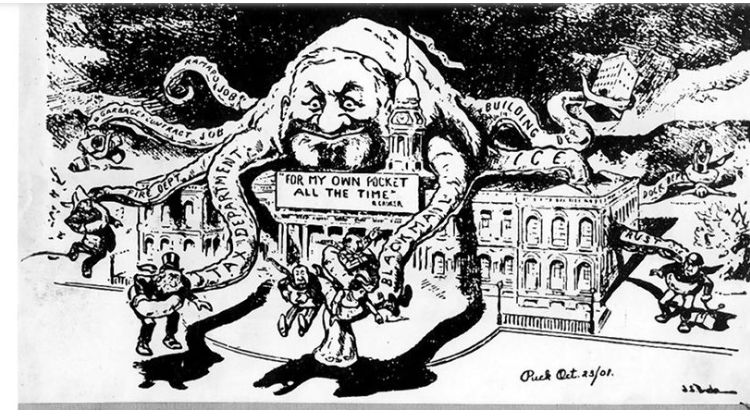
A DANGEROUS SITUATION: Came across an anecdote about Jefferson M. Levy in a recently digitized article from the Philadelphia Post from November of 1903. In it, the paper snarkily relates a story involving Levy and the infamous Richard “Boss” Croker, the Irish-born (1843-1922) New York City Democratic political strongman who dominated the city’s politics from the early 1880s until he returned to Ireland in 1905.


It seems that in 1898 when Jefferson Levy first ran for a seat in the U.S. House of Representatives from New York (and won) he had forgotten that, as the paper put it, “shortly after he began to live at Monticello” [in 1879], he had gone “to London and had cards printed bearing this legend…”

Jefferson
Monticello
Levy
Virginia

When the wily Crocker got wind of the business cards, he summoned Levy (below, in an 1890s newspaper sketch), and the conversation went something like this:

Crocker: “Mr. Levy, I understand one of the daily newspapers has one of those cards you were using in London and intends to print a picture of it.”

Levy: “Well?”

Crocker: “Well? Don’t you see the connection? If they print that card, like as not you will be barred from Congress. You say you are from Virginia, and you are elected to Congress from New York. You must get that card at all hazards. You must be cautious about it, too.

“If the newspaper people hear you want the card, they will doubtless print it. I like you and want to help you, but I warn you that this is a dangerous situation.”

At which point, the article noted, Levy “rushed away, very much frightened.”

During the “rest of the campaign, he had daily consultations with Mr. Croker as to ways and means for getting the card from the newspapers, and each morning he picked up that journal in fear and trembling and looked for the reproductions.”

The article reported that Croker enlisted some members of the NYC Democratic Club to help retrieve the potentially damning card. “There were hours of consultations over dinner tables,” the article pointed out, “Levy always picking up the checks.”
Then one day Croker and company presented Levy with the card—and “demanded” that Levy “provide a banquet for those who had saved his seat in Congress.” Levy “responded liberally, and to this day he thinks he was kept in Congress by the efforts of Croker and his friends.”


Thomas Nast cartoon showing Boss Croker's tentacles ensnaring N.Y. City Hall
That article was the first I’d heard of the business card blackmail scheme—which doesn’t mean it’s not true. On the other hand, Jefferson Levy was no fool, and it stretches credulity to think that he’d fall for a blatant blackmail attempt that involved paying for lots of food and drink for his political bosses. On the other hand, crossing Boss Crocker would have cost Levy his critical support, and it’s entirely possible that’s why Levy kept paying for all those meals.

If so, that patronage paid off. Jefferson Levy ran for Congress three times, and won each race: in 1898, 1910, and 1912.

MARCH EVENTS:

·        On Saturday, March 21, I’ll be receiving a National Daughters of the American Revolution History Award at the monthly meeting of the Falls Church DAR chapter in Falls Church, Virginia.

·        On Thursday, March 26, I’m giving a talk on my one and only Civil War book, Desperate Engagement: How a Little-Know Civil War Battle Saved Washington, D.C., and Changed American History, as part of the Civil War Lecture Series at the GAR Hall in Peninsula, Ohio. More info at peninsulahistory.org/cwls

There’s always a chance I may add a last-minute talk or signing. For the latest on that, or to check out my other scheduled 2020 events, go to the Events page on my website at http://bit.ly/Eventsandtalks

If you’d like to arrange an event for Saving Monticello, or for any of my other books, please send an email to marcleepson@gmail.com For info on my latest book, Ballad of the Green Beret, go to http://bit.ly/GreenBeretBook

GIFT IDEAS:  Want a personally autographed, brand-new paperback copy of Saving Monticello? Please e-mail me. I also have a few as-new, unopened hardcover copies, along with a good selection of brand-new copies of my other books.


Monday, February 3, 2020

February 2020


Saving Monticello: The Newsletter
The latest about the book, author events, and more
Newsletter Editor - Marc Leepson

Volume XVII, No. 2                                                       

February 1, 2020

The study of the past is a constantly evolving, never-ending journey of discovery.” – Eric Foner

THREE-POUND DIAMOND: “The Second-Biggest Diamond in History Has a New Owner.” That headline in The New York Times on January 15 caught my attention because—well, who isn’t interested in the second-biggest diamond in recorded history?

The headline also called to mind something I’d discovered about Jefferson M. Levy twenty years ago while researching Saving Monticello. Going through stacks of newspaper clippings in the archives of the American Jewish Historical Society in New York City back then, I found two 1905 articles about Levy and the “largest diamond on record.” 


Turns out that Jefferson Levy, the big New York City real estate and stock speculator who owned Monticello from 1879-1923, was the largest American stockholder in a syndicate called Premier Diamond that had just extracted a half-pound, 3,032-carat diamond out of a mine near Pretoria, South Africa.

Here’s the gist of what I wrote about that state of events in Saving Monticello: Levy, a “rich speculator,” I noted, “got immensely richer in January of 1905” when the South Africa miners discovered that giant stone

That state of events prompted the New York American on January 30 to ask: ‘Will Jefferson M. Levy, former [and future, as it would turn out] Congressman, capitalist and owner of Monticello, be the diamond king of America? Will his ownership of a large share of the great Premier diamond mine of the Transvaal from which a 3,032-carat stone was taken a few days ago, make the New Yorker a rival of the late Cecil Rhodes?’ ”

Levy, the paper went on to say, “will not say, but he does admit that luck has showered wealth upon him from an unexpected source which may exceed the wildest dreams of his fancy.”


“I really got into this thing quite by accident,’ Levy told the paper, “Constantly I am making investments, and when the diamond shares were offered me at what I considered a very low price, I took them. But even with my real estate and other large holdings, I almost forgot the Premier stock.”

The January 15, 2020, NYT article reported that the baseball-sized second-biggest diamond (below) that was discovered last year was the “the largest rough diamond discovered since 1905.” That 1905 stone, which would become known as Cullinan Diamond, likely was the one that Levy’s Premier Mine unearthed. Levy’s syndicate sold it to the government of South Africa  (then known as The Transvaal), for around $750,000. 


The government subsequently had it cut it up into two giant stones, and in 1907, in a goodwill gesture to help heal the wounds of the long (1899-1902) Boer War, gave the two stones to King Edward VII of England. Today they are incorporated into the English monarchy’s Crown Jewels. You can read the entire New York Times article at http://bit.ly/JMLdiamond

EVENTS: I have one event this month. On Wednesday, February 5, I’ll be doing a talk on Saving Monticello and a book signing at The Village at Orchard Ridge retirement community in Winchester, Virginia.


There’s always the chance that I may add a last-minute talk or signing. For the latest on that, or to check out my other scheduled 2020 events, go to the Events page on my website at http://bit.ly/Eventsandtalks

If you’d like to arrange an event for Saving Monticello, or for any of my other books, feel free to send me email at marcleepson@gmail.com For info on my latest book, Ballad of the Green Beret, go to http://bit.ly/GreenBeretBook

GIFT IDEAS:  Want a personally autographed, brand-new paperback copy of Saving Monticello? Please e-mail me.  I also have a few as-new, unopened hardcover copies, along with a good selection of brand-new copies of my other books.


Tuesday, January 7, 2020

January 2020


Saving Monticello: The Newsletter
The latest about the book, author events, and more
Newsletter Editor - Marc Leepson

Volume XVII, Number 1                                          January 1, 2020

The study of the past is a constantly evolving, never-ending journey of discovery.” – Eric Foner

HAPPY 2020: And happy 17th anniversary to the Saving Monticello newsletter. This publication began in 2003 after I had attended a book-marketing panel at the Virginia Book Festival in Charlottesville and one expert advised starting a newsletter. I went with the newsletter form because in those days weblogs had just become known as “blogs” and weren’t on my radar.

I don’t know if I thought back then how long I’d keep doing the newsletter, but it’s pleasantly surprising that I have produced one every month since. It’s also been an unexpected pleasure to regularly find material I hadn’t come across while doing the research for the book twenty years ago.
Thanks very much to all the SM Newsletter subscribers—especially those who have told me about newspaper and magazine articles and other primary-source materials that were new to me. I continue to search digital archives (thank you, Google University) for potential newsletter items, often while doing research for my other books. It’s always a shot in the arm when I come upon newly digitized material that augments what I have written in the book about the history of Monticello.

For example: I just found a one-paragraph article from The Sun, the old New York City newspaper, dated October 9, 1887, that provides details of Jefferson Monroe Levy’s ownership of the Merchants’ Hotel in New York City. That article buttresses what I wrote in Saving Monticello about how Levy became a millionaire around that time primarily through buying, selling, and managing real estate in his hometown—and in Charlottesville. (He also had great success as a stock market speculator.)
I described some of Jefferson Levy’s more notable real estate dealings in the book. But I hadn’t known that he owned the Merchants’ Hotel for four years. 

The Merchants' Hotel
One of New York City’s oldest hotels, dating from the late 18th century, the Merchants’ also was one of the city’s most exclusive. It was “famous before the Astor House [the city’s first luxury hotel] was built in 1836,” according to the article. Jefferson Levy purchased the place in 1883 (four years after he’d bought Monticello) for $80,000, and sold it in 1887 for $185,000, more than doubling his investment.

Levy did well in that business venture. As the article noted, he also had received “$11,000 in rents from it, beside his profit on the present transfer.”

In the early and mid 19th century the Merchants’ Hotel on Cortlandt Street in Lower Manhattan—as its name implies—was a home away from home for out-of-town merchants. They came in New York mostly from the West and South, usually on semi-annual trips to “purchase goods [from][ the great wholesale houses,” as an October 10, 1887, New York Evening World article put it in announcing the sale—but not naming its new owner. The hotel “in those days was a much larger and more pretentious hostelry than it is now,” the paper said, “and covered two lots adjoining” Broadway. “It was a favorite resort for the merchants… who flocked here in thousands.”  


The article went on to note that those merchants, with their “persuasive eloquence,” were known to “break the hearts of the chambermaids and dining-room girls right and left.” 

Dining-room girls?

James Monroe (Thomas Jefferson’s Albemarle County neighbor) stayed at the Merchants’ Hotel in June 1817 when he became the first sitting U.S. president to visit the Big Apple, according to the 1915 book, Old Taverns of New York by William Harrison Boyles.

After a visit to City Hall to meet with the city’s mayor, Jacob Radcliff, and New York’s Gov. DeWitt Clinton, Boyles wrote, the President “was escorted by a squadron of cavalry to the quarters provided for him at Gibson’s elegant establishment, the Merchants’ Hotel in Wall Street.”

Following another round of official duties, President Monroe “returned to the hotel at five o’clock and sat down to a sumptuous dinner prepared for the occasion.” Among the guests were the former New York Gov. Daniel Tompkins, who then was Monroe’s Vice President, and sitting N.Y. Gov. Clinton.

The Merchants’, Boyles noted, was “selected as a proper place to lodge and entertain the President of the United States” because “there is hardly a doubt that it was considered second to none in the city.” The Merchants’ Hotel is long gone. Today, the 54-story skyscraper called One Liberty Plaza takes up the entire block of Cortlandt Street where the hotel stood, between Church Street and Lower Broadway, two blocks east of the 9/11 Memorial.


EVENTS: I have one event in January. On Sunday, January 12, I’ll be doing a talk on Saving Monticello for Sephardi Federation of Palm Beach County, Florida, at Temple Shaarei Shalom in Boynton Beach. I’ve done more than 225 talks on the book since it came out in 2001, but this will be a first. I’ll be doing it live—but electronically via Zoom.


There’s always the chance that I may have a last-minute talk or signing. For the latest on that, or to check out my scheduled 2020 events, go to the Events page on my website at http://bit.ly/Eventsandtalks

If you’d like to arrange an event for Saving Monticello, or for any of my other books, feel free to email me. For info on my latest book, Ballad of the Green Beret, go to http://bit.ly/GreenBeretBook

GIFT IDEAS:  Want a personally autographed, brand-new paperback copy of Saving Monticello? Please e-mail me at marcleepson@gmail.com  I also have a few as-new, unopened hardcover copies, along with a good selection of brand-new copies of my other books.


Monday, December 2, 2019

December 2019


Saving Monticello: The Newsletter
The latest about the book, author events, and more
Newsletter Editor - Marc Leepson

Volume XVI, Number 12                                                       December 1, 2019

The study of the past is a constantly evolving, never-ending journey of discovery.” – Eric Foner

A RATHER FAMOUS PERSONALITY: On April 13, 1956, Thomas Jefferson’s 212th birthday, the U.S. Postal Service issued a new twenty-cent stamp at a ceremony at Monticello. The blue-and-white stamp shows the west front of Thomas Jefferson’s “Essay in Architecture,” the so-called “nickel view.” William K. Shrage who worked at the federal Bureau of Engraving and Printing in Washington, designed the stamp.


Postmaster General Arthur E. Summerfeld spoke at the unveiling ceremonies that day at Monticello. In his remarks, Summerfield lauded Thomas Jefferson—and Monticello. The house, he said, reflects the “living evidence of the inner life of Jefferson.” Noting its “strength and dignity,” the Postmaster General said Monticello also “possesses deep artistic and cultural values,” has “noble simplicity,” is “highly practical and warmly livable,” and has “long been a symbol of our leadership for freedom.”

The new stamp, he said, “will herald to all the world our continued dedication to human freedom.”

Eleven years later, in June 1966, Linn’s Weekly Stamp News published an article by Dr. Oscar Stadtler—a Cleveland dentist with a strong interest in Jewish history and philately—titled “Of Monticello—And Uriah P. Levy.” In it, Dr. Stadtler wrote about Monticello’s unexpected “Judaica connection;” that is, the Levy family’s stewardship—the subject of Saving Monticello.

In the article, Dr. Statdler admiringly quoted from a Thomas Jefferson Memorial Foundation brochure, which reported that the Foundation bought Monticello from the Levy family, “which had owned it for over 75 years.”


Steve Lewis, a Levy descendant (a great grandnephew of Jefferson Levy and a great-great-great grandson of Uriah Levy’s mother, Rachel), kindly sent me a copy of this fascinating stamp magazine article, which I hadn’t seen.

I was pleased to see that most of the facts in Dr. Stadtler’s article about Uriah and Jefferson Levy and their ownership of Monticello were correct.

On the other hand, Dr. Stadtler had several facts wrong—most likely because he used the unreliable 1963 Uriah Levy biography, Navy Maverick, as his main source.

Most of the misstatements are trivial, including Jefferson Levy’s age when he died (he was 71, not 70). But Dr. Stadtler quoted from a letter that’s cited in Navy Maverick that is all but certainly made up. In it, Uriah Levy supposedly is writing to a business acquaintance in 1832, extolling Jefferson as the “greatest men in history—author of the Declaration of Independence and an absolute democrat.”
He goes on to laud Jefferson for doing “much to mold our Republic in a form in which a man’s religion does not make him ineligible for political or government life. As a small payment for his determined stand on the side of religious liberty I am preparing to personally commission a statue of Jefferson.”

I quoted that letter in Saving Monticello, but pointed out in an endnote that the authors provided no information about the letter’s whereabouts, nor did they give its exact date. What’s more, I have repeatedly tried (as have other historians) to find the letter, and have come up empty. 

Despite its dubious nature, that quote is often repeated as a convenient explanation for Uriah Levy’s 1832 decision to commission a seven-and-a-half-foot-tall statue of Thomas Jefferson in Paris. Among many other places, you can find the quote on the Uriah Levy page on Monticello’s website, which was written by Professor Mel Urofsky in 2001 and includes Navy Maverick as a source. It’s also on the UPL Wikipedia page.

Another error in Dr. Stadtler’s article: He says Uriah Levy decided to live at Monticello after he bought it in 1836 (the papers were signed in 1834, but closing was held up for two years), which is untrue. Then U.S. Navy Lt. Levy spent comparatively little time at Monticello, although he moved his elderly mother, Rachel Phillips Levy, into the house in 1837. She died two years later at Monticello, where she is buried along Mulberry Row.

Uriah’s permanent address when he wasn’t on a cruise was in New York City. He certainly visited Monticello, sometimes for weeks at a time, but not very often. On the other hand, I cannot argue with Dr. Stadtler’s characterization of Uriah Levy as “a rather fabulous personality.” If you read Saving Monticello, you will see just how fabulous he was.


THE MEDALLION: Uriah Levy, as I noted in Saving Monticello, spent a good deal of time in Paris during his Navy days. He even lived there for a year beginning in August 1828. The next time he returned to the City of Light, in 1832, Levy arrived with a mission: to commission a larger-than-life sculpture of Thomas Jefferson from one of the best-known sculptors of the day, Pierre Jean David d’Angers (1788-1856).

I covered that experience in depth in the book, including mentioning the oft-quoted suspect letter explaining why Lt. Levy took that extraordinary step.
I didn’t realize until recently that David—the leading monument maker in Paris whose many commissions for statues, portraits, busts and medallions came from patrons throughout the world—also created a bronze portrait medallion of Uriah Levy at about the same time, most likely at Uriah’s request.


Susan Stein, Monticello’s long-time curator, emailed me last month to say that she had unexpectedly come across a copy of the medallion at the David d’Angers Gallery, which is located in the restored 13th century Toussaint Abbey (above), in David’s home town, the city of Angers in the Loire Valley.

I did a bit of searching and found that another copy is in the National Gallery of Art’s West Building in Washington, D.C., along with a sixteen-inch high bronze maquette of the Jefferson statue by David d’Angers that now stands in Statuary Hall in the Rotunda of the U.S. Capitol a few blocks away. As Susan told me, it’s great to see a “new” life portrait of Uriah Phillips Levy. That’s the medallion below, showing the forty-year-old, hirsute Navy lieutenant.


EVENTS: I have one event in December. On Thursday, December 12, I will be doing a talk on Saving Monticello and a book signing at the Washington, D.C. SAR Chapter’s annual Holiday Dinner in Washington, D.C.


There’s always the chance that I may have a last-minute talk or signing, especially around Christmas. For the latest on that, or to check out my scheduled 2020 events, go to the Events page on my website at http://bit.ly/Eventsandtalks

If you’d like to arrange an event for Saving Monticello, or for any of my other books, feel free to email me. For info on my latest book, Ballad of the Green Beret, go to http://bit.ly/GreenBeretBook

GIFT IDEAS:  Want a personally autographed, brand-new paperback copy of Saving Monticello? Please e-mail me at marcleepson@gmail.com  I also have a few as-new, unopened hardcover copies, along with a good selection of brand-new copies of my other books.

Tuesday, November 5, 2019

November 2019


Saving Monticello: The Newsletter
The latest about the book, author events, and more
Newsletter Editor - Marc Leepson


Volume XVI, Number 11                                                       November 1, 2019

The study of the past is a constantly evolving, never-ending journey of discovery.” – Eric Foner

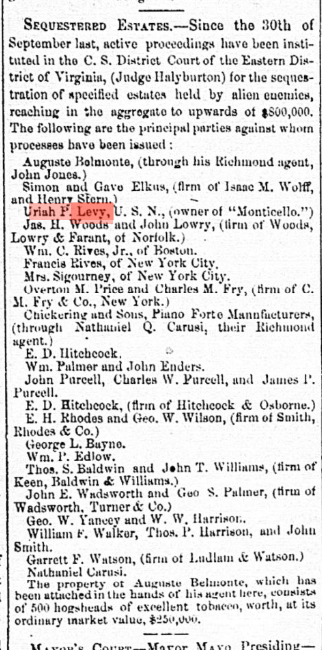
SEQUESTRATION: As I wrote in Saving Monticello, the Confederate States of America seized all of Uriah Levy’s Virginia land (including Monticello) under the sequestration terms of the CSA’s Alien Enemies Act—the law that the Confederate Congress had passed and Jefferson Davis had signed on August 8, 1861.

The Act called for the removal of all residents of northern states from the Confederacy. It also authorized the CSA to take possession of property in the South owned by ousted northerners. The clip below from the October 11, 1861, Richmond Enquirer, contains a list of the largest northern landowners in Virginia and their estates. The properties—which the article calls “estates held by alien enemies” would be confiscated—AKA “sequestered.”


According to an another article in the Richmond Examiner, which I quoted from in the book, the proceedings to sequestrate Monticello began on October 10, 1861, while “the present owner, Levy, [was] abroad being in charge of a United States ship of war.” The article went on to point out that the “people of Charlottesville called the late owner of Monticello ‘Commodore Levee.’ He is a first Captain in the United States Navy, and of Jewish parentage.”

Frank Leslie's Illustrated Newspaper of New York City reported the sequestration four months later, saying that Thomas Jefferson’s Monticello had been confiscated, along with “all its lands, negroes, cattle, farming utensils, furniture, paintings, wines, etc., together with two other farms belonging to the same owner, and valued at from $70,000 to $80,000.” The Union-friendly newspaper went on to expound on Uriah Levy’s patriotism and military service, and concluded: “Certainly no officer in the army or navy has been so victimized by the rebels.”

Coda: Uriah Levy fought the order in the Confederate courts; and the suit continued, as I note in the book, after he died in 1862. Finally, in November of 1864, the CSA prevailed and Monticello was sold to Benjamin Franklin Ficklin, a Confederate Army officer, who was forced to relinquish the property to Levy’s heirs after the Civil War ended in March 1865. Ficklin had paid the CSA $80,000 (in Confederate money) for the property.

NAVAL ACADEMY:  It’s not every day that you get escorted through the security gate  into the U.S. Naval Academy—much less give a talk following Friday night services at the amazing Miller Chapel, the certerpiece of the Academy’s Commodore Uriah P. Levy Center.

But that’s what happened on October 11, when Benno Gerson of the Friends of the Jewish Chapel and Rabbi Steve Ballaban, the Naval Academy’s Jewish Chaplain, graciously welcomed me to the gleaming chapel.


Rabbi Ballaban told me he’d keep the service short—and he was true to his word.

He then gave me a terrific introduction and I proudly stood in front of a group of midshipmen and members of the Annapolis Jewish community to fill them in on the life of  Uriah P. Levy and his family, his distinguished naval career, as well as his—and his nephew Jefferson M. Levy’s—stewardship of Monticello, the heart of Saving Monticello.

It was a memorable evening, made even more special when I signed books for the Midshipmen and FOJC members at the Oneg following the service. My thanks to everyone who made the evening possible, especially Mr. Gerson, Rabbi Ballaban, and David Hoffberger, the facilities manager for all of the Naval Academy’s chapels.
         
SOUTHERN JEWISH: I had another memorable Saving Monticello experience on Friday, October 25, when I did the Keynote Speech at the 44th annual Southern Jewish Historical Society Conference in Charlottesville. The Conference organizer, Phyllis Leffler, an emeritus professor of U.S. History at the University of Virginia, invited me to do the talk, as well as to accompany two busloads of conference goes on an 8:30 a.m. special tour of Monticello that morning.

We broke into four groups and had a great tour that ended at the grave of Rachel Levy, Uriah Levy’s mother, who died at Monticello in 1839, and is buried on Mulberry Row (photo below). After the tour, we drove back to Charlottesville for lunch (featuring the famed local Bodo’s bagels) at the Brody Jewish Center, the home of U-Va.’s Hillel, a block from the University of Virginia’s grounds. I did the talk as the last bagels were being consumed.


I am extremely grateful to Phyllis Leffler, the current SJHS President and the Conference Program Committee Chair and Georgia State University History Professor Marni Davis, as well Hillel Rabbi Jake Rubin and Danielle Buynack, the Hillel Development Director, for putting on a special event.                                            
    
CORRECTION: Last month I mentioned that the Saturday morning Lift program at Congregation Kol Ami in White Plains, New York, was started by Harley Lewis—the Levy descendant who has helped me immeasurably with my research of her family and Monticello—and her late husband Dick. Harley emailed me, though, to say that they did not start Lift. “It was the genius of [Kol Ami] Rabbi Shira [Milgrom],” she wrote. “But we were at the first one… along with a few other congreganants and became devoted fans” of the program. I stand corrected—and honored that I was asked to be speak about Saving Monticello and the Nunez/Phillips/Levy family at the September 21, 2019, Lift.

EVENTS: I have two events in November. On Wednesday, November 6, I will be doing a talk on Saving Monticello and a book signing at the monthly luncheon meeting in Potomac, Maryland, of a retiree group of a large corporation.

The following evening, Thursday, November 7, at 7:00, I will be part of the screening of an excellent documentary called “Just Like Me: Vietnam War Stories from All Sides” by the filmmaker Ron Osgood at the McGowan Theater at the National Archives in Washington, D.C. The event is free and open to the public. I will join Ron on stage after the screening to discuss it and take audience questions. For more info, go to http://bit.ly/ArchivesScreening 


There’s always the chance that I may have a last-minute talk or signing. For the latest on that, or to check out my scheduled 2019 events, go to the Events page on my website at http://bit.ly/Eventsandtalks

If you’d like to arrange an event for Saving Monticello, or for any of my other books, feel free to email me. For info on my latest book, Ballad of the Green Beret, go to http://bit.ly/GreenBeretBook

GIFT IDEAS:  Want a personally autographed, brand-new paperback copy of Saving Monticello? Please e-mail me at marcleepson@gmail.com  I also have a few as-new, unopened hardcover copies, along with a good selection of brand-new copies of my other books.