Wednesday, June 3, 2020

June 2020


Saving Monticello: The Newsletter
The latest about the book, author events, and more
Newsletter Editor - Marc Leepson

Volume XVII, Number 6                                                          June 1, 2020

The study of the past is a constantly evolving, never-ending journey of discovery.” – Eric Foner

UNCLE JEFF: Jefferson Levy’s mother Fanny served as his unofficial hostess at Monticello soon after the life-long bachelor bought out his uncle’s heirs and gained control of the property in 1872. Following Fanny Levy’s death in 1893, Jefferson Levy’s sister, Amelia Mayhoff, took over that job.

As I noted in Saving Monticello, Amelia Levy had married Carl Mayhoff, a New York City cotton broker, in 1890. They lived most of the year in New York City on East 34th Street, the same block where Jefferson Levy lived. The Mayhoff’s son, Monroe, was born in 1897.

Sisters Agnes and Frances Levy with their cousin, Monroe Levy, on the lawn circa 1902

During the seasons when she was in charge at Monticello, Amelia Mayhoff arranged innumerable social events, with and without her brother present. She and her husband occupied a suite of rooms on the first floor. 

The other family members who spent the most time at Monticello were Jefferson Levy and Amelia Mayhoff’s brother L. Napoleon, his wife Lilian Hendricks Wolff, and their four daughters—Frances, Agnes, Florence, and Alma. The account I gave of their days at Monticello in the book was primarily based on a mid-1970s interview with Florence Levy Forsch—along with copies of hand-written letters her older sister, Frances Wolff Levy Lewis, wrote from Monticello in 1902 when she was nine years old.

Uncle Jeff

Just last week, Frances Lewis’ grandson Richard Lewis kindly sent me two pages from a short, unpublished memoir she wrote in the early 1960s, in which she remembers Jefferson Levy and visits to Monticello. Most of what she writes jibes with her sister Florence’s remembrances, as well as with all with the other primary-source materials about Jefferson Levy and Monticello during his ownership that I’ve uncovered. But the memoir also contains some observations that I’d not come across before.

Frances Lewis described her uncle as a “very tall and big man,” and said that her family visited “Uncle Jeff” regularly at his lavish New York City townhouse on 34th Street. She said that her Aunt Amelia “kept house for her family,” as well as for her two bachelor brothers, Jefferson M. and Mitchell Abraham Cass Levy.

She went on to give a revealing glimpse into Jefferson Levy’s early twentieth century lifestyle.

“On Sunday mornings,” she wrote, “we would be sent in to see Uncle Jeff, who would be lying on a big four poster bed, surrounded by the Sunday papers and there would be two big greyhounds stretched on the bed beside him.

The memoir confirms, as Fran Lewis put it, that during their childhood she and her sister Agnes “often were brought down to stay a few weeks in Monticello in the summer.” She said that her Aunt Amelia—who liked her nieces to call her “auntie”—presided over a household with a good number of African American “maids who lived in the old slave quarters, which were underground outside the main house.”

Today, those quarters, known as the South Wing, house several exhibits that document the lives of enslaved African Americans at Monticello. The lineup includes the spectacular digital exhibit on the life of Sally Hemings and the Getting Word project, which tells the history of Monticello’s enslaved people primarily through the oral histories of their descendants. There’s also the restored post-1809 Kitchen and Cook’s Room.

Fran Lewis describes her aunt Amelia as “a smart woman and a gracious hostess to many important people who came to visit Uncle Jeff and [who] gave many parties in the beautiful parlor where there was a large malachite table and many fine oil paintings.

“The floor was highly polished and we children were never allowed to enter that room except on one occasion when President Theodore Roosevelt came to visit [on June 17, 1903] and Agnes and I and Monroe were sent in to shake hands with him.”

Jefferson Levy, she said, “slept in Thomas Jefferson’s room,” known today as the Bed Chamber, which famously features Jefferson’s alcove bed. It’s conceivable that Jefferson M. Levy slept in the alcove bed.

On the other hand, a visitor to Monticello in 1900 wrote that Jefferson Levy installed “a gold Louis XV bed” on a “dais” in the Bed Chamber, upholstered in “damask, while voluminous blue damask curtains draped to each side fell from a gold coronet that hung from the ceiling.”

Fran Lewis said that her uncle had “many” greyhounds, including his favorite, Duke, who “always slept in Uncle Jeff’s room.”

Fran (who was known as Fanny as a child) described some of the farming operations at Monticello, including a “field with about 50 Shetland ponies and one Palomino, which belonged to Monroe, who would ride him around the back lawn.”

Frances Lewis at Monticello, 1959

Thomas Rhodes, Jefferson Levy’s overseer at Monticello, also ran a diary operation on the mountain. “There were cows,” Fran Lewis said, “and in the evenings we would go down the hill to watch them be milked, and even tried to do it ourselves.”

The children also occasionally played in the Jefferson family cemetery. “We would go down the hill and squeeze between the bars,” Fran Lewis wrote, “and play inside. Back at the house, the children “would chalk out a hop scotch” on the roof of the former slave quarters. When it rained, they scampered up one of the narrow staircases in the house to the top floor, and explored the Dome Room “where all sorts of things were stored, including a two wheeled gig that Thomas Jefferson rode in when he went to sign the Declaration of Independence.”


L. Napoleon Levy (wearing the dark hat) and his daughters Agnes, Alma (on the pony), Fanny, and Florence, with their cousin Monroe Mayhoff (holding the pony). The man on the right, is Willis Henderson, who worked for Jefferson Levy at Monticello. Photo courtesy of the Lewis family.


Jefferson, indeed, did drive that one-horse gig, which was built by enslaved people at Monticello, on two six-day journeys from the mountain to the Continental Congress in Philadelphia in 1775 and 1776. As I noted in Saving Monticello, the gig remained unused and unchanged after it was stowed away upstairs at Monticello following Jefferson’s death, although its wheels and shaft had disappeared by the time Jefferson Levy had taken over.


The house and grounds “were truly beautiful,” Fran Lewis wrote, “as Jefferson Levy spent large sums of money restoring the house and buying furnishings.”

That sentence is 100 percent accurate, and jibes with every other first-person account of Monticello during Jefferson Levy’s ownership.

EVENTS: My scheduled live events for the spring and summer have been canceled or postponed due to the pandemic. To check out my scheduled late 2020 events, go to the Events page on my website at http://bit.ly/Eventsandtalks

If you’d like to arrange an event for Saving Monticello, or for any of my other books, feel free to send me email at marcleepson@gmail.com  For info on my latest book, Ballad of the Green Beret, go to http://bit.ly/GreenBeretBook

GIFT IDEAS:  Want a personally autographed, brand-new paperback copy of Saving Monticello? Please e-mail me.  I also have a few as-new, unopened hardcover copies, along with a good selection of brand-new copies of my other books. 

Monday, May 4, 2020

May 2020


Saving Monticello: The Newsletter
The latest about the book, author events, and more
Newsletter Editor - Marc Leepson

Volume XVII, Number 5                                                                     May 2020

The study of the past is a constantly evolving, never-ending journey of discovery.” – Eric Foner

LEVY LAUNCHING: The United States Navy considers Uriah Levy a genuine hero. And rightfully so. Uriah Phillips Levy joined the Navy in 1812 at age twenty. He served with distinction during the War of 1812 as assistant sailing master of the USS Argus, which wreaked havoc with British shipping in the English Channel, capturing and burning more than two dozen ships.

He went on to have a fifty-year career in the Navy, the first Jewish American to do so. He rose through the ranks to become a Commodore, the Navy’s then-highest rank, becoming the first Jewish American Navy Commodore.

Uriah Levy also was primarily responsible for abolishing flogging in the U.S. Navy. He began a campaign to do so in the 1840s, which led to congressional action abolishing that antiquated, brutal punishment.

The Navy first formally recognized Uriah Levy—who owned Monticello from 1834 until his death in 1862—during World War II by naming a newly commissioned Cannon-class destroyer escort the USS Levy in 1943.

The USS Levy at sea in the Pacific during World War II
The Levy, dubbed a “sub-killer,” was launched at 1:45 in the afternoon of March 28, 1943, at the Port Newark Yards in New Jersey. “The swift and deadly ‘sub-killers’ are nearly as large as destroyers,” the New York Herald Tribune reported, “but of simpler construction and less heavily armed. They [weigh] 1,300 tons each and cost about $3.5 million each.” Their “armament includes guns heavy enough for surface engagements with submarines, anti-aircraft batteries, depth charges and torpedo tubes.”

Twenty years ago, while researching Saving Monticello, I discovered that Jefferson Levy’s sister Amelia Mayhoff, (and Uriah’s niece), hosted (“sponsored” in Navy parlance) the ceremonial launching. But I just learned some other facts about the ship and the Levy family from an article that Levy descendant Tom Lewis recently ran across and kindly sent to me.


The article, in the Long Branch, N.J., Record, reports that the idea to name a ship in honor of Uriah Levy came from a veterans service organization, the Jewish War Veterans of the United States, which lobbied the War Department to do so. It also notes that Tom Lewis’ grandmother Frances Lewis (referred to as “Mrs. Harold L. Lewis”) represented the family at the ceremonies.
The Levy went on to perform well during World War II. The ship served in the southern and central Pacific from August 1943 through the end of the fighting. Among its accomplishment of note, the Levy supported the invasion of the Marianas in the summer of 1944, and its officers hosted the surrender ceremonies of the Japanese Navy in the southeastern Marshall Islands at Mili Atoll.
  
BABBLING BROOKE: Sometimes during my talks on Saving Monticello I take a brief detour when I get to Maude Littleton—who led the 1911-18 campaign to take Monticello from Jefferson Levy—to talk about her husband, Martin Wiley Littleton.

A prominent lawyer and one-term Democratic Congressman from Long Island, New York, Martin Littleton (1872-1934) was a noted figure in his own right. His notoriety derived primarily from his skillful defense of the playboy millionaire Harry K. Thaw in the 1908 second round of the first media-celebrated American “trial of the century.”

Shaw had shot and killed the renowned architect Stanford White on the rooftop of Madison Square Garden. That sensationally sordid affair—the subject of E.L. Doctorow’s novel (and the film and Broadway show) Ragtime—centered on White’s affair with Mrs. Shaw, the famed model and actress Evelyn Nesbit known as “The Bird in the Gilded Cage” because her husband kept her away from society.

Knowing most post-Baby Boomers likely don’t know the name Evelyn Nesbit, I used to explain that she was the “Madonna of her time.” That’s given way to the Kim Kardasian or the Lada Gaga of her time.

Evelyn Nesbit, "The Bird in the Gilded Cage"

I flashed back to Evelyn Nesbite when I recently learned of a connection between Jefferson M. Levy and Frances Evelyn “Daisy” Maynard (1861-1938), another beautiful, flamboyant early 20th century woman. Born into British high society, she later became Lady Brooke and then the Countess of Warwick after her husband, Francis Grevile, Lord Brooke, became the 5th Earl of Warwick. Rumor had it that Lady Brooke inspired the popular song “Daisy Bell (Bicycle Bult for Two),” which burst on the scene in 1892 when she was 31 and one of London’s most famous and active socialites. Her media nicknames included “The It Girl,” “My Darling Daisy,” and “Babbling Brooke.”

Lady Brooke’s flamboyant lifestyle included open love affairs with several rich and famous Englishmen, including Lord Charles Bereford, a renowned British Navy admiral and member of Parliament. She had a ten-year affair with Albert Edward, the Prince of Wales, who later acceded to the British throne as King Edward VII in 1901, ushering in the Edwardian Era.

Lady Brooke

What’s Lady Brooke’s tie to Monticello? Well, in 1907, at the height of her celebrity, she journeyed to the United States for a whirlwind of high-society activity. Lady Brooke spent most of that time in New York City, where she stayed with none other than Jefferson M. Levy, the big real estate and stock speculator—and very eligible bachelor—whom the Charlottesville Daily Progress described as her “legal adviser.”

In October, the Countess decided to make a trip to Monticello, her legal adviser’s country home in Virginia. Later that month Levy—a pre-jet jetsetter who hobnobbed with royals and other upper-crusters on two continents—hosted a dinner for the Bishop of London at Monticello. Among his guests was his house guest, the Countess of Warwick.

That’s the extent of our knowledge about the relationship between one of Europe’s most flamboyant socialites and one of America’s richest men. I will continue to search for more.  

EVENTS: Just one event in May. On Sunday afternoon, May, 3, I did a Zoom talk as a fund-raising benefit for the nonprofit Mosby Heritage Area Association, a historic preservation group that focuses on “preservation through education” in the Northern Virginia Piedmont where I live.
My scheduled live events for the spring and summer have been canceled or postponed due to the pandemic. To check out my scheduled late 2020 events, go to the Events page on my website at http://bit.ly/Eventsandtalks

Doing the Zoom talk in the shadow of the Bull Run Mountains

If you’d like to arrange an event for Saving Monticello, or for any of my other books, feel free to send me email at marcleepson@gmail.com  For info on my latest book, Ballad of the Green Beret, go to http://bit.ly/GreenBeretBook

GIFT IDEAS:  Want a personally autographed, brand-new paperback copy of Saving Monticello? Please e-mail me.  I also have a few as-new, unopened hardcover copies, along with a good selection of brand-new copies of my other books.


Saturday, April 4, 2020

April 2020


Saving Monticello: The Newsletter
The latest about the book, author events, and more
Newsletter Editor - Marc Leepson

Volume XVII, Number 4                                                                                                                       April 1, 2020

The study of the past is a constantly evolving, never-ending journey of discovery.” – Eric Foner

IN MEMORIAM: I am deeply saddened to report that Harley Lewis, a great-grandniece of Uriah Levy and a grandniece of Jefferson M. Levy—and one of the last members of her generation of Levy descendants—died at her home in White Plains, New York, on March 24 at 94. My deepest condolences to Harley’s sons Richard, Jim, and Tom, and her brother Phillip, and to their families.

Harley was born on November 13, 1925, the daughter of Harold L. Lewis and Frances Levy Lewis, who was known as Fanny. Harley’s maternal grandfather was L. Napoleon Levy, Jefferson M. Levy’s brother. Her great-great grandmother—Uriah Levy’s mother, Rachel—is buried along Mulberry Row at Monticello after having died there in 1839, five years after Uriah purchased Monticello from James Turner Barclay.

Harley Lewis, circa 2011. Photo courtesy of Richard Lewis

According to her New York Times obituary, Harley graduated from Syracuse University in 1957, married Richard C. Lewis, and worked as a librarian in the Edgemont Public School system in Scarsdale, New York, and at Congregation Kol Ami in White Plains. Harley and Dick Lewis were very active in that congregation for many years. She served on its board, and was a founding member of the Westchester Coalition of Food Pantries & Soup Kitchens.

Harley was the keeper of much of her family’s Monticello history. When I started researching Saving Monticello in 1999, Dan Jordan, then the president of the Thomas Jefferson Foundation (which owns and operates Monticello), and Susan Stein, Monticello’s curator, spoke admiringly of Harley and strongly suggested that I contact her.

I visited Harley and Dick at their home in Westchester County and they couldn’t have been more kind, gracious, and welcoming. After feeding me lunch, Harley and I went through her extensive collection of family materials and she shared every one with me. Among many other things, she kindly gave me a copy of the unpublished memoir of her great grandfather, Jonas Levy, one of Uriah’s brothers. And she gave us permission to use two family photos in the book.  

Here’s one of them: a picture of Harley’s mother Frances sitting in the buggy with her sister Agnes, with their cousin Monroe Levy on the lawn at Monticello sometime in the 1890s.


Harley told me about her mother and father’s recollections of visiting Monticello in the 1930s—and the less-than-welcome reception they (and other family members) felt there. On at least one occasion, they were refused permission to visit Rachel Levy’s grave, which was hidden from public view behind a locked gate.

That situation didn’t substantially change until 1984 when Dan Jordan took over at the Foundation and began an effort to have the Levys’ role officially recognized at Monticello. The first step was refurbishing the Rachel Levy grave site and placing a plaque there honoring the family.
On June 7, 1985, Harley and Dick Lewis and other family members and guests took part in a commemorative ceremony there. Dan Jordan welcomed everyone, saying the occasion marked the beginning of the Foundation’s recognition of the Levys’ “good stewardship” of Monticello.

The highlight came when Harley Lewis unveiled a new plaque at her great-great grandmother’s newly refurbished grave site that concluded with the words: “At two crucial periods in the history of Monticello, the preservation efforts and stewardship of Uriah P. and Jefferson M. Levy successfully maintained the property for future generations.”

Harley faithfully read every issue of this newsletter and regularly emailed me with kind words after each one came out. Her last email arrived on March 3. In it, she wrote, “You always come up with fascinating bits of family history. It makes my day to receive this news. Don’t stop sleuthing.”
I won’t, Harley.

BETH ELOHIM: On a mid-March visit to Charleston, South Carolina, we had the chance to visit the historic Kahal Kadosh Beth Elohim Synagogue two weeks before the nation went into widespread quarantining. The majestic building in downtown Charleston, which dates from 1840, is the country’s second oldest synagogue and the oldest one in continuous use. The congregation, which started in 1749, is the fifth oldest in the U.S. behind:


Shearith Israel, which began in 1654 in New York City

Congregation Jeshuat Israel, founded in 1658 in Rhode Island; its Touro Synagogue, dedicated in          1763, is the nation’s oldest synagogue building

Mickve Israel in Savannah, founded in 1733

Mikveh Israel in Philadelphia in 1740

The Nunez, Machado, and Levy families—including Uriah P. Levy and Jefferson M. Levy—worshiped at Shearith Israel and Mickve and Mikveh Israel. Work on the latest restoration of the sanctuary at Beth Elohim had ended just days before we toured the place. Took these pics:


EVENTS: I had several events scheduled for April. They’ve been cancelled or postponed due to the coronavirus pandemic. Hope to have speaking events set up this fall.  
To check out my scheduled late 2020 events, go to the Events page on my website at http://bit.ly/Eventsandtalks

If you’d like to arrange an event for Saving Monticello, or for any of my other books, feel free to send me email at marcleepson@gmail.com  For info on my latest book, Ballad of the Green Beret, go to http://bit.ly/GreenBeretBook

GIFT IDEAS:  Want a personally autographed, brand-new paperback copy of Saving Monticello? Please e-mail me.  I also have a few as-new, unopened hardcover copies, along with a good selection of brand-new copies of my other books.

Tuesday, March 3, 2020

March 2020


Saving Monticello: The Newsletter
The latest about the book, author events, and more
Newsletter Editor - Marc Leepson

Volume XVII, Number 3                                           

March 1, 2020

The study of the past is a constantly evolving, never-ending journey of discovery.” – Eric Foner

NEW EDIFICE: Members of the Levy/Phillips/Nunez family have been associated with New York City’s Shearith Israel, the nation’s oldest Jewish congregation, since 1734. That’s the year that David Machado, who married Uriah Levy’s great grandmother, Zipporah Nunez, moved to New York from Savannah to become the temple’s Hazzan (Prayer Reader). 

As I noted in Saving Monticello, as Hazzan, The Reverend Machado, as he was known, had many duties, including granting licenses to inspect and kill cattle under Jewish dietary laws. He also conducted religious services and was responsible for reciting certain prayers.


Uriah Levy, who—when he wasn’t at sea or spending time at Monticello—lived in New York City from the 1820s until his death in 1862, was a member of the congregation. And his nephew, L. Napoleon Levy (Jefferson Levy’s brother), served as president of the Shearith Israel Congregation in the 1890s and early 1900s.

L.N. Levy, like his older brother Jefferson, was a New York City lawyer. In fact, the brothers became law and business partners. The younger Levy, who died at age 66 in 1921, headed the Congregation when the decision was made to build its fifth and current building on West 70th Street and Central Park West on an uptown plot of land that been a duck farm.


The noted New York City architect and city planner Arnold Brunner (1857-1925) designed the imposing neo-classical building. Louis Comfort Tiffany did the interior design work, including—naturally—the stained glass windows.

When it came time to lay the cornerstone for the new building, on May 20, 1896 (8 Sivan, 5656 on the Hebrew calendar), L. Napoleon Levy was given the honor. To mark the occasion, the Congregation presented him with an engraved trowel. A big thank you to Steve Lewis, a great-great grandnephew of Jefferson Levy, for sending me the terrific image of the trowel below.


The “fine new structure,” as the New York Journal and Advertiser put it, was dedicated, a year later, on May 19, 1897. Today, an engraved plaque on the ground floor recognizes L. Napoleon Levy’s leadership of Shearith Israel, and an auditorium in the synagogue is named in his honor.

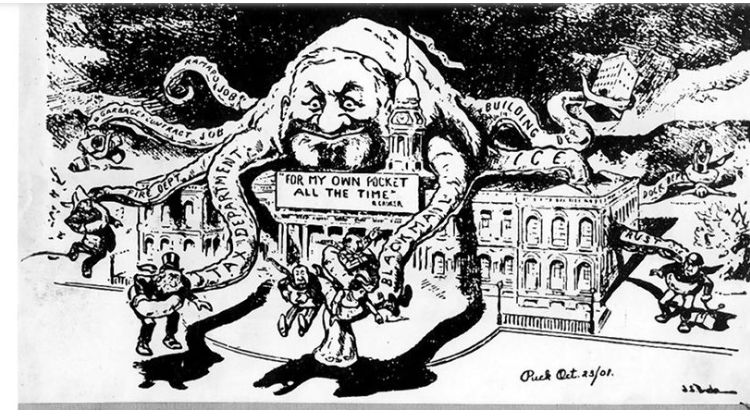
A DANGEROUS SITUATION: Came across an anecdote about Jefferson M. Levy in a recently digitized article from the Philadelphia Post from November of 1903. In it, the paper snarkily relates a story involving Levy and the infamous Richard “Boss” Croker, the Irish-born (1843-1922) New York City Democratic political strongman who dominated the city’s politics from the early 1880s until he returned to Ireland in 1905.


It seems that in 1898 when Jefferson Levy first ran for a seat in the U.S. House of Representatives from New York (and won) he had forgotten that, as the paper put it, “shortly after he began to live at Monticello” [in 1879], he had gone “to London and had cards printed bearing this legend…”

Jefferson
Monticello
Levy
Virginia

When the wily Crocker got wind of the business cards, he summoned Levy (below, in an 1890s newspaper sketch), and the conversation went something like this:

Crocker: “Mr. Levy, I understand one of the daily newspapers has one of those cards you were using in London and intends to print a picture of it.”

Levy: “Well?”

Crocker: “Well? Don’t you see the connection? If they print that card, like as not you will be barred from Congress. You say you are from Virginia, and you are elected to Congress from New York. You must get that card at all hazards. You must be cautious about it, too.

“If the newspaper people hear you want the card, they will doubtless print it. I like you and want to help you, but I warn you that this is a dangerous situation.”

At which point, the article noted, Levy “rushed away, very much frightened.”

During the “rest of the campaign, he had daily consultations with Mr. Croker as to ways and means for getting the card from the newspapers, and each morning he picked up that journal in fear and trembling and looked for the reproductions.”

The article reported that Croker enlisted some members of the NYC Democratic Club to help retrieve the potentially damning card. “There were hours of consultations over dinner tables,” the article pointed out, “Levy always picking up the checks.”
Then one day Croker and company presented Levy with the card—and “demanded” that Levy “provide a banquet for those who had saved his seat in Congress.” Levy “responded liberally, and to this day he thinks he was kept in Congress by the efforts of Croker and his friends.”


Thomas Nast cartoon showing Boss Croker's tentacles ensnaring N.Y. City Hall
That article was the first I’d heard of the business card blackmail scheme—which doesn’t mean it’s not true. On the other hand, Jefferson Levy was no fool, and it stretches credulity to think that he’d fall for a blatant blackmail attempt that involved paying for lots of food and drink for his political bosses. On the other hand, crossing Boss Crocker would have cost Levy his critical support, and it’s entirely possible that’s why Levy kept paying for all those meals.

If so, that patronage paid off. Jefferson Levy ran for Congress three times, and won each race: in 1898, 1910, and 1912.

MARCH EVENTS:

·        On Saturday, March 21, I’ll be receiving a National Daughters of the American Revolution History Award at the monthly meeting of the Falls Church DAR chapter in Falls Church, Virginia.

·        On Thursday, March 26, I’m giving a talk on my one and only Civil War book, Desperate Engagement: How a Little-Know Civil War Battle Saved Washington, D.C., and Changed American History, as part of the Civil War Lecture Series at the GAR Hall in Peninsula, Ohio. More info at peninsulahistory.org/cwls

There’s always a chance I may add a last-minute talk or signing. For the latest on that, or to check out my other scheduled 2020 events, go to the Events page on my website at http://bit.ly/Eventsandtalks

If you’d like to arrange an event for Saving Monticello, or for any of my other books, please send an email to marcleepson@gmail.com For info on my latest book, Ballad of the Green Beret, go to http://bit.ly/GreenBeretBook

GIFT IDEAS:  Want a personally autographed, brand-new paperback copy of Saving Monticello? Please e-mail me. I also have a few as-new, unopened hardcover copies, along with a good selection of brand-new copies of my other books.