Friday, July 12, 2024

July 2024


Saving Monticello: The Newsletter

The latest about the book, author events, and more

Newsletter Editor - Marc Leepson


Volume XXI, Number 7                                                         July 2024 


EARLY IMAGES: Twenty-five years ago, I was immersed in doing the research for the book that would become Saving Monticello. That research included searching for historical images of the house and grounds, along with images of the notable people who lived, worked, and visited there. I came across more than two dozen photographs and other images, 19 of which are in the book.

That includes the image on the cover of the hardcover and paperback—the oldest known photograph of Monticello, which dates from around 1870. Taken by William Roads, a Charlottesville photographer, the original photograph is archived in the Special Collections of the University of Virginia Alderman Library, which is where I found it, along with another of Roads’ images of Monticello taken at the same time. Since then, no older photographs of Monticello have surfaced. 


I included old photos of Monticello’s post-Jefferson owners—Benjamin Franklin Ficklin, James Turner Barclay, Uriah Phillips Levy, and Jefferson Monroe Levy—in the book. And since its publications in 2001, while putting together this newsletter, I’ve discovered additional images of the Levys, as well as their families and other visitors to the mountaintop, a good number of which have been digitized since the book came out. 

Which brings us to the news of a recently discovered vintage photo of a prominent and frequent Monticello late eighteenth and early nineteenth century visitor, the famed First Lady, Dolley Madison. Earlier this year, a family found the photograph—a daguerreotype—which was taken in 1847, making it the oldest photo of a U.S. First Lady. It’s at least 30 years older than the one on the book’s cover 

According to newspaper reports, the anonymous family discovered the image earlier this year when cleaning a “dead relative’s basement,” sent it to Sotheby’s, and the big auction house’s experts determined that the image was taken by a Virginia photographer named John Plumbe, Jr. in 1847, when Dolley Madison was in her seventy-ninth year. Plumbe sold his photography business the next year. 


The image went to auction earlier this summer, and the Smithsonian’s National Portrait Gallery snapped it up for $456,000. The photo will go on view at the Portrait Gallery in 2026, as the nation commemorates the semiquincenntenial (250th) anniversary of the signing of the Declaration of Independence, after which it will become part of the museum’s permanent collection. 

“This artifact will provide the Smithsonian another opportunity to tell a more robust American story,” Smithsonian Secretary Lonnie G. Bunch III, said, “and illuminate the vital role women like Madison have played in the nation’s progress.” 

The Portrait Gallery also has in its collection the oldest known photograph of a U.S. president. It’s another daguerreotype, this one of John Quincy Adams in Washington, D.C., taken in March 1843 by the photographer Philip Haas, just four years after that photography process which uses copper plates lined with a thin sliver of silver to create images was invented. It has been on display at the D.C. museum since 2018. J.Q. Adams, who served as the sixth President from 1825-29, was a member of the U.S. House of Representatives from Massachusetts at the time. 


Both Dolley Madison and her husband James, who lived in Montpelier about 30 miles north of Monticello, had strong ties to Thomas Jefferson and Monticello. 

Before James Madison succeeded Jefferson as the nation’s fourth president in 1809, his wife helped the widowed Jefferson host social events at the White House (then known as the President’s House) while her husband was serving in the House of Representatives on the other side of Pennsylvania Avenue. 

Dolley Madison soon became famous for her lively, weekly receptions at the White House for the political and social movers and shakers in the Nation’s Capital. 

The Madisons also were frequent visitors and guests at Monticello, before and after Jefferson’s presidency. So frequent that Jefferson’s grandchildren—his daughter Martha Randolph’s offspring—who lived at Monticello named one of the upstairs bedrooms “Mr. Madison’s Room” even though both Mrs. and Mr. Madison stayed there often, sometimes as long as several weeks at a time. 

There is no record of John Q. Adams visiting the Mountaintop. However, he did attend dinners and other social events at the White House when Jefferson was in office from 1801-09. 

And, as I wrote in Saving Monticello, when he heard the news that his father and Jefferson both died on July 4, 1826, the 50th anniversary of the founding of the nation, J.Q. Adams memorably wrote in his diary that both founding fathers dying on that notably day was a “visible and palpable” manifestation of “Divine favor.” 

EVENTS: Just one scheduled this month. On Saturday, July 13, I’ll be speaking about the Civil War Battle of Monocacy and Confederate General Jubal Early’s subsequent attack on Washington, D.C., at the Fort Stevens Day event in Northwest D.C. near Silver Spring, Maryland. It’s a commemoration of the 160th anniversary of the fighting that went on there on July 11-12, 1864. It’s free and open to the public. For more info, go to https://theparksdc.com/event/fort-stevens-day-160-anniversary 


I will have more events in the fall and winter. For details, check the Events page on marcleepson.com/events 

COMMERCE: If you would like a new paperback of Saving Monticello, I have a few on hand. To order that book, or the just-published hardcover of Huntland, go to this page on my website https://bit.ly/BookOrdering or email me at marcleepson@gmail.com 

I also have a few used Saving Monticello hardcovers, and a stack of five of my other books: Flag: An American Biography; Desperate Engagement; What So Proudly We Hailed; Flag: An American Biography; and Ballad of the Green Beret. 

Thursday, June 20, 2024

June 2024


Saving Monticello: The Newsletter

The latest about the book, author events, and more

Newsletter Editor - Marc Leepson


Volume XXI, Number 6                                                         June 2024


JML & THE UDC: In mid-November 1912 the battle between Jefferson Levy and his supporters and Maude Littleton and her backers over her well-financed plan to have the government assert eminent domain, confiscate Monticello, and turn it into a government-run house museum was reaching a crescendo. 

A bill that Mrs. Littleton (as she was referred to in the newspapers of the day) and her allies on Capitol Hill had written would do exactly, and it would soon be coming up for a vote in the House of Representatives. The bill came out of a series of bombastic hearings during the summer and fall in which the two camps—led by Maude Littleton and the congressmen supporting her effort, and by Jefferson Levy and his lawyer, Judge Tom Duke of Charlottesville—verbally sparred over Monticello’s fate.

As the adversaries worked to gain support before the vote, the United Daughters of the Confederacy—a then-influential descendants group founded in 1894 whose members were blood relatives of Confederate soldiers or those who supported the South’s cause in the Civil War—came into the picture.


Although I wrote a fair amount about other events surrounding what some people called “The War of 1912” in Saving Monticello, I only recently learned new details about Mrs. Littleton’s interactions with the most-influential American hereditary groups, including the UDC and the Daughters of the American Revolution, about the pending legislation. The DAR spurned her offer to support the government-takeover plan, but proposed an alternative, having a private group (such as the DAR) run Monticello as a house museum open to the public. As I wrote in the book, DAR leaders later would make a case before Congress to do just at that. It did not come to fruition. 

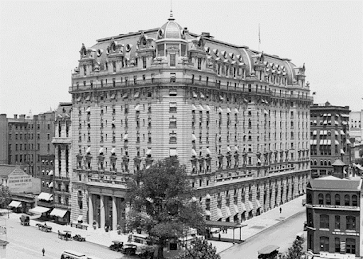
Meanwhile, in November 1912, the UDC briefly stepped into the Levy-Littleton imbroglio. It came about during the organization’s 9th annual convention at the lavish Beaux-Arts-style Willard Hotel in Washington (in photo below) during which Mrs. Littleton showed up to lobby UDC members to endorse her plan. But she left the city without addressing the body, after the convention did not take up the matter when the proceedings ended on November 16.

Spurning Maude Littleton may have been due to the fact that the convention received a letter from Jefferson Levy “reiterating,” a Richmond Times Dispatch reporter wrote, “his oft-repeated declaration that he does not wish to sell the historic home.” 

In the letter Levy also lambasted Mrs. Littleton and her supporters for “the abuse” of his family and for her “misstatements and disregard of the care I have bestowed on the property.” 

At the convention’s last session, the UDC elected new members, then “applauded a statement with reference to the right of the South to have succeeded,” as a Washington Times reporter put it. Then came an address by a Union Civil War veteran that “had many of the delegates weeping” after the man spoke about the ceremonies of the dedication of the cornerstone of a Confederate Memorial at Arlington National Cemetery a week earlier.** 


After the convention ended, word got out that influential UDC members, including Mrs. Frank Anthony Walke (as the newspapers referred to her) of Norfolk, Virginia, the UDC’s Custodian of the Flags, opposed a government seizure of Monticello. But the Daughters were not averse to their organization running the property, an idea that Mrs. Walke said Jefferson Levy agreed to do at some unspecified time in the future. 

Monticello, she told a reporter, “belongs to Virginia in the future, and the government shall not own it. Mr. Levy has promised that the Virginia division of the [UDC] shall have the old home of Jefferson. I have his personal assurance that the property shall go to us when he has finished its use.” She went on to say that she would oppose “any proposition for [Monticello’s] acquisition by the United States which may be advanced by Mrs. Littleton.” 

Mrs. Walke then sarcastically advised Maude Littleton to have “the government purchase all the historical places in the North, South, East and West, and to preserve them. But Virginia can take care of her property, particularly when it is not [on] the market.” 

That didn’t exactly go over with Mrs. Littleton. “Don’t pay any attention to Mrs. Walke,” she said the day after the convention ended. “She is just a silly, little thing—a little foolish thing—a busybody who is trying to get even with me because I wouldn’t okay her railroad fare to Washington and her hotel expenses there.” 

Then she added: “I don’t care a row of pins about Jefferson Levy. He is nothing but a stumbling block in the way of our great purpose. All I am thinking about is Thomas Jefferson.” 


Mrs. Littleton went on to say that the famed populist politician and orator William Jennings Bryan (above, orating) had “informed Mr. Levy” that “we are going to have Monticello.” Bryan, she said, assured her “that he would fight while he had breath in his body to have Monticello set aside as a public memorial.” 

William Jennings Bryan, a venerator extraordinaire of Thomas Jefferson, had written to Jefferson Levy in 1897 suggesting that he sell Monticello to the federal government, which would turn it into a national shrine. Six months earlier Bryan, the Democratic Party nominee, had narrowly lost the 1896 presidential election to William McKinley. 

In November 1912, William Jennings Bryan did, indeed, come out in support of Mrs. Littleton’s cause. But Bryan, who died in 1925, never saw the government take Monticello from Jefferson Levy—though he (and Mrs. Littleton) did live to see the newly formed nonprofit Thomas Jefferson Memorial Foundation, purchase Monticello from Levy in 1923 and begin the process of turning it into a privately run house museum. 

**That memorial, the largest in the cemetery, was commissioned by the UDC and dedicated in 1914. It was created by the Virginia-born sculptor and diehard former Confederate soldier, Moses Ezekiel. The memorial was removed from the cemetery on December 22, 2023.

 EVENTS: Aside from a talk at an informal gathering of folks near where I live, I don’t have any speaking engagements for Saving Monticello or any of my other books in June. In other event news, Steve Pressman’s great 2022 documentary, “The Levys of Monticello,” which was inspired by my book, is now available (with ads) for free on Amazon Prime. 

In other news, the pub date for my next book, The Unlikely War Hero, a different kind of Vietnam War POW true story, is December 17. You can get a sneak preview at https://bit.ly/PrePubInfo 


And the 11th printing of the SM paperback, published by the University of Virginia Press, is now available in bookstores and online. If you would like an autographed copy of the hardcover, I have a few on hand, along with brand-new paperbacks. To order, go to this page on my website: https://bit.ly/BookOrdering or email me at marcleepson@gmail.com  

I also have six of my other books: Flag: An American Biography; Desperate Engagement; What So Proudly We Hailed; Flag: An American Biography; Ballad of the Green Beret; and Huntland. There’s more info on all those books on my website.

Saturday, May 11, 2024

May 2024

 Saving Monticello: The Newsletter

The latest about the book, author events, and more

Newsletter Editor - Marc Leepson


Volume XXI, Number 5                                                        May 2024


STATUARY: I have been known to describe Jefferson Monroe Levy as “an early 20th century jetsetter” because of his frequent, first-class excursions to Europe. In keeping with that peripatetic lifestyle, Levy spent most of the summer of 1905 on the Continent. 

Near the end of that trip, in September, as I wrote in Saving Monticello, JML was the guest of honor at an elaborate ceremony put in the historic city of Angers in the Pays de la Loire region of France. The occasion: the high-rolling real estate and stock speculator’s presentation of a replica of the David d’Angers statue of Thomas Jefferson his uncle Uriah Levy had commissioned in 1833 to the Musée David, now the Musée des beaux-arts d’Angers. 

Levy had made good on a promise he had made a year earlier to France’s Ambassador to the United States, Jules Jusserand. During a visit to Monticello, the Frenchman had remarked that the city of Angers regretted not having a copy of the famed David statue (below, now displayed in the U.S. Capitol Rotunda), and Levy promised he’d have one fabricated. Early in the summer of 1905 JML arranged to have the reproduction made and shipped to Angers.


Levy and his traveling companions, the American Ambassador to France Robert Sanderson McCormick (1849-1919, a nephew of the inventor, Cyrus McCormick) and the artist George Torrey and his wife, took a train from Paris on September 16, and arrived in Angers for the formalities. The Angers railway station was decked out for the occasion with American and French flags. 

Museum officials had placed the Jefferson in the center of the museum’s Great Gallery surrounded by French and American flags. Special carpets were put down, hundreds of chairs brought in, and busts by David of George Washington and James Fenimore Cooper placed next to the larger-than-life Jefferson statue.

Levy addressed the gathering with a short, flowery speech, in which he praised the city of Angers, the nation of France, the Marquis de Lafayette, Uriah Levy, David d’Angers, and, of course, Thomas Jefferson, whom Levy called “the greatest statesman and philosopher of modern times.” 

After a round of champagne and cake, the mayor gave the Levy party a tour of the museum as the band played “Yankee Doodle.” A guided tour of the town followed. 

That evening, JML was the guest of honor at a banquet at Angers’ Grand Hotel. The next day he and the Torreys had lunch at the American consulate and then took a train back to Paris. 

Jefferson Levy received several gifts from the folks in Angers, that day, including two Sevres vases and a statuette, a reproduction of the noted French painter and sculptor Paul Dubois’ “Military Fortitude.” 

In my ongoing quest to unearth new (to me) information about Uriah and Jefferson Levy’s lives at Monticello, I recently learned more details about the Dubois statute when I came across a front-page article in May 28, 1906, Richmond Times Dispatch, headlined, “Levy to Put French Gift in Monticello.” 


I did a little digging and found that Dubois (1829-1905) was a prolific and acclaimed French artist and sculptor, whose work in marble was influenced by his study of Italian Renaissance sculpture. Dubois created “Military Fortitude” (also known as “Military Courage”) in 1879 as one of a group of four bronze statues for the four corners of the ornate tomb (below) of a noted French general, Louis de la Moncière (sometimes spelled de Lamoricière), a native of Nantes who had died in 1865 and was entombed in the 15th century Nantes Cathedral. 

Dubois dubbed the tomb’s other statues, which represented the departed general’s three other virtues, “Wisdom,” “Charity,” and “Faith.” In the late 1800s, a French foundry produced a fair number of reproductions of “Military Fortitude/Courage” in varying sizes. 

The Tomb

William T. Walters (1820-1894), the wealthy Baltimore businessman and art collector, acquired a life-sized version. He bequeathed it to the City of Baltimore and it stands today on Mount Vernon Square, just north of Downtown Baltimore, along with that city’s Washington Monument, virtually overlooking the famed Walters Art Museum. The statue Jefferson Levy received, on the other hand. was much smaller, standing just 51 centimeters (20 inches) in height.    

Not that the art-loving Levy didn’t have large statues displayed at Monticello during the time he owned the property, from 1879-1923. As I wrote in Saving Monticello, he had life-sized marble statues of what were known locally as Venus, Apollo, and Jupiter installed on the lawn. 

Below are early 20th century photos of two of them. The first statue appears to be a copy of a classical statue of the Greek good Nemesis in the Vatican Museum. The second likely is a copy of a Roman noblewoman, although it could be Venus.


Disclaimer: I do not claim to be an art historian, so if you can identify these statues, I’d love to hear from you.

Coda: None of the Levy statuary remains at Monticello. Most likely Jefferson Levy’s sister Amelia, who inherited his estate after he died in March 1924, disposed of them before turning the property over to the Thomas Jefferson Memorial Foundation, which had purchased it from her brother, along with its furniture and furnishings, in December 1923. 

On the other hand, the Foundation may have auctioned the statues off with all of the other Levy furniture and furnishings after it took control of the property. In its desire to expunge all things Levy from Monticello, the Foundation held a public auction of all of its non-Jefferson contents in 1928. The long list of Jefferson Levy’s items the Foundation ridded itself of included tables and chairs, sofas, carpets, chandeliers, clocks, vases, paintings, lamps, beds, bureaus, dressers, chests, and a pair of twin beds. Some of the larger items were shipped to New York City where they were sold at auction at the Plaza Hotel. 

On each item foundation officials pasted a label that said that the piece had come from Monticello during the Levy period.

EVENTS: None scheduled this month. And I’ll be taking most of the month of June off, mainly getting away from it all (most of it, anyway) in Charleston, S.C. Will have more events later in the summer and fall. For details, check the Events page on marcleepson.com/events 

THE 11th PRINTINGThe University of Virginia Press will soon be distributing the latest paperback edition of Saving Monticello, which the Press began publishing in 2003 after the Simon & Schuster hardcover went out of print. The new eleventh printing should be available later this month.

During the time between printings, on April 4, I took a peek at SM’s Amazon page and did a double take when I saw that the book’s Kindle version was the site’s No.1 best-selling book in Historic Preservation. I took a screenshot to preserve that milestone:


If you would like a new paperback of Saving Monticello, I have a few on hand. To order that book, or the just-published hardcover of Huntland, go to this page on my website https://bit.ly/BookOrdering or email me at marcleepson@gmail.com 

I also have a few used Saving Monticello hardcovers, and a stack of five of my other books: Flag: An American Biography; Desperate Engagement; What So Proudly We Hailed; Flag: An American Biography; and Ballad of the Green Beret. You can read back issues of this newsletter at http://bit.ly/SMOnline


EVENTS: None scheduled this month. And I’ll be taking most of the month of June off, mainly getting away from it all (most of it, anyway) in Charleston, S.C. Will have more events later in the fall. For details, check the Events page on marcleepson.com/events


THE 11th PRINTINGThe University of Virginia Press will soon be distributing the latest paperback edition of Saving Monticello, which the Press began publishing in 2003 after the Simon & Schuster hardcover went out of print. The new 11th printing should be available later this month. During the time between printings, on April 4, I took a peak at SM’s Amazon page and did a double take when I saw that the book’s Kindle version was the site’s No.1 best-selling book in Historic Preservation. I took a screenshot to preserve that milestone:

If you would like a new paperback of Saving Monticello, I have a few on hand. To order that book, or the just-published hardcover of Huntland, go to this page on my website https://bit.ly/BookOrdering or email me at marcleepson@gmail.com 

I also have a few used Saving Monticello hardcovers, and a stack of five of my other books: Flag: An American Biography; Desperate Engagement; What So Proudly We Hailed; Flag: An American Biography; and Ballad of the Green Beret. 

Thursday, April 11, 2024

April 2024


Saving Monticello: The Newsletter

The latest about the book, author events, and more

Newsletter Editor - Marc Leepson


Volume XXI, Number 4                                                         April 2024


  In memory of Dan Jordan


DANIEL P. JORDAN, 1938-2024: There’s no doubt in my mind that Saving Monticello would not have been the publishing success it’s been without the generosity and graciousness of Dan Jordan, who led the Thomas Jefferson Foundation from 1985-2008, and could not have been more helpful to me as I researched and wrote the book in the late nineties and after it came out in the fall of 2001. 

Dan, who died at 85 on March 25, and Susan Stein, then as now Monticello’s senior curator, were my guiding lights at the Foundation. 

They always took the time and effort to answer my questions, made great research suggestions, and paved the way for the Foundation’s most-welcome and extremely important support of the book, which continues to this day. 

Among many other things for which I will be eternally grateful, Dan hosted my very first book talk and signing at the old Monticello Visitor’s Center in late October 2001. Dan and Susan were extremely welcoming when we arrived on the mountaintop the afternoon of the talk and at the event itself. I can still see Dan sitting attentively and proudly in the audience.  

Dan regularly wrote to me during the next seven years while he headed the Foundation. That continued after he retired, as he shared always-positive thoughts with me on the book’s success, on this newsletter—which he subscribed to—and on “The Levys of Monticello,” Steven Pressman’s great, award-winning 2022 documentary inspired by my book, in which Dan appeared. That’s him below in the Jefferson Library in a still from the documentary.


Daniel Porter Jordan, Jr. was born in Philadelphia, Mississippi. He was a standout baseball and basketball player at the University of Mississippi, majoring in English and history. He received his BA and his MA in history from Ole Miss, where was elected president of the student body. 

He trained in Army ROTC at Mississippi and went on active duty after getting his MA. After getting out of the Army, Dan earned a Ph.D. in history from the University of Virginia in 1970. After that, he taught U.S. History, specializing in the colonial period, at the University Richmond and at Virginia Commonwealth University before accepting the job as the head of the Thomas Jefferson Foundation in late 1984. He became the first historian to lead the Foundation. 

You can find lots more details on Dan’s life and work at Monticello in the excellent obituaries by Richard Sandomir in The New York Times and Harrison Smith in The Washington Post at https://bit.ly/NYTJordanObit and https://bit.ly/WPJordanobit

Championing the Levys’ Cause 

I am so thankful to Dan for his steadfast support for my work—and for championing the Foundation’s recognition of the Levy Family’s crucial 89-year stewardship of Monticello. Dan’s advocacy on behalf of the Levys began not long after he accepted the job at the Foundation.   

I told that inspiring story of Dan’s role in recognizing the Levys in Saving Monticello, and it’s worth summarizing here. Dan filled me in on the details when we sat down 25 years ago to discuss how it all came about. He told me that a month after he began his official duties on the mountaintop on January 1, 1985, his friend Saul Viener—a Richmond businessman, biblical scholar, and historian, and the founder of the Southern Jewish Historical Society—wrote to Rabbi Malcolm Stern in Norfolk to relay the news that Dan was the new head of the Thomas Jefferson Foundation. 

“A wonderful choice,” he wrote to Rabbi Stern, who did pioneering work in Jewish-American genealogy. “When I phoned him congratulations, he brought up the Levy family! 

Viener, Stern, Virginius Dabney (the Pulitzer-Prize-winning editor-in-chief of the Richmond Times-Dispatch), and Irving Lipkowitz, a longtime Richmond lawyer who also had championed the Levys, soon thereafter “began working on Jordan,” in Stern’s words. Dan corroborated that when we spoke. 

“Almost immediately after the announcement I started to hear from various Jewish friends—some were imminent scholars and some just had an interest in history—as well as from Virginius Dabney,” Dan said, “all with the same message: namely, that an important story was not being told at Monticello.” 

His friends convinced him. “I looked into it. What I was told was correct," Dan told me. “I went to the [Foundation] Board and asked about it. The Board, I think, was genuinely naive. No one could recall, in their opinions as trustees, any issues or controversies. But all agreed that we needed to find a way to tell an important story.” 


With the blessing of the Foundation’s Board of Trustees, Dan Jordan led the effort to have the Levys’ role officially recognized at Monticello. The first step was refurbishing the gravesite of Rachel Levy—Uriah Levy’s mother who died at Monticello in 1839 and is buried along Mulberry Row—and placing a plaque there honoring the family. That done, Dan planned a formal re-dedication of the gravesite. 

Rabbi Stern helped the Foundation contact several Levy descendants, and on June 7, 1985, family members and several dozen guests took part in a joyful commemorative ceremony at Monticello. 

Dan welcomed the guests, saying the occasion marked the beginning of the Thomas Jefferson Foundation’s recognition of the Levys’ “good stewardship” of Monticello. 

“This morning,” he said, “we are pleased to honor the Levy family who, for the better part of a century, owned and preserved this priceless estate, which is perhaps unique in our land for its combination of historic significance and scenic beauty.”

Edgar Bronfman, the head of World Jewish Congress and CEO of Joseph E. Seagram & Sons, made the principal address. Bronfman, who owned a large estate in Albemarle County, had agreed to speak at the behest of Saul Viener and Dan Jordan. 

In his remarks, Bronfman focused on Thomas Jefferson and Uriah Levy. Monticello, Bronfman said, “was rescued from destruction by a Jewish-American naval officer whose own fiery independence led him through a highly successful but storm-tossed career in the service of his country.” 

Following a scripture reading by Charlottesvilles Temple Beth Israel’s rabbi, and a prayer from Louis C. Gerstein of New York Citys Sephardic Congregation Shearith Israel (the nation’s oldest Jewish congregation where Levy family members worshipped), Levy descendant Harley Lewis unveiled the new plaque (in photo below) at her great-great grandmother’s grave. 


Since that auspicious day, the Foundation has taken many other steps to recognize the Levy familys important role at Monticello. That includes an exhibit in the Robert H. and Clarice Smith Gallery at the Visitor Center and the updated, illustrated marker at Rachel Levy’s grave. (in photo below).


Rescuing the story of the Levys at Monticello was but one of Dan Jordan’s many other accomplishments as head of the Foundation. As Jane Kamensky, the Foundation’s new president, wrote after his death: 

Dan Jordan “was the most consequential president on the Mountaintop since Jefferson himself. It’s no exaggeration to say that everything we understand about modern Monticello stems from Dan’s long, fruitful, and collaborative tenure as President of the Foundation, for more than thirty years, beginning in 1985. 

“A historian with a deep belief that scholarly excellence must drive visitor experience, he presided over the creation of the [International Center for Jefferson Studies], Getting Word, and the Jefferson Library. He then followed the scholarship where it led: to the acceptance of Jefferson’s relationship with Sally Hemings, in many ways the backbone of the interpretations we share today.” 

Ann Lucas, Monticello’s Senior Historian Emerita, has put together a stirring tribute to Dan and his work at Monticello on the Foundation’s website at https://bit.ly/DanJordan  It includes words of remembrance of Dan as a scholar, leader, and as a person from past and present Monticello staff and scholars. I am honored that Ann included my words in that group. 

I proudly repeat my last sentence here: Dan Jordan was, in every respect, a great man. 

EVENTS: Save the date: The pub date for my next book, The Unlikely War Hero, a different kind of Vietnam War POW true story, is December 17. You can get a sneak preview at https://bit.ly/PrePubInfo

I have three in-persons events this month. On Sunday, April 14, I’ll be doing a talk on the Huntland book with the architectural historian Maral S. Kalbian, my indispensable collaborator, at Foxcroft School in Middleburg, Va., followed by a tour of the Huntland estate, stables, and kennels. It’s a fundraiser for the Virginia Piedmont Heritage Area. The event is sold out. 

On Wednesday, April 17, I’ll be taking part in a panel discussion. “The Life and Legacy of Francis Scott Key, Class of 1796,” at St. John’s College (FSK’s alma mater) beginning at 7:30 p.m. It’s free and open to the public. Details at https://bit.ly/FSKPanel

On Thursday, April 25, I’ll be doing a talk on the life of Key, based on my biography, What So Proudly We Hailed, at the Glebe Retirement Community in Daleville, Virginia. For more details on these and future events, please check the Events page on my website: marcleepson.com/events 

THE 11th PRINTING:  My friends at the University of Virginia Press tell me that the paperback Saving Monticello, which the Press began publishing in 2003 after the Simon & Schuster hardcover went out of print, will be going into its 11th printing. The paperback now is on backorder until physical copies come off the presses.  

In the meantime, if you would like a new paperback of Saving Monticello, I have a few on hand, along with a few as-new used hardcovers.

To order those books, or the recently published hardcover of Huntland, go to this page on my website:

 https://bit.ly/BookOrdering or email me at marcleepson@gmail.com 

I also have a stack of five of my other books: Flag: An American Biography; Desperate Engagement; What So Proudly We Hailed; Flag: An American Biography; and Ballad of the Green Beret.

The SM Newsletter on Line: You can read back issues of this newsletter at http://bit.ly/SMOnline

Monday, March 25, 2024

March 2024


Saving Monticello: The Newsletter

The latest about the book, author events, and more

Newsletter Editor - Marc Leepson


Volume XXI, Number 3                                                         March 2024


COLLEGE TOPICS: I was doing my usual snooping around online a few weeks ago, looking for hitherto undigitized primary-source material about Monticello during the Levy Family’s ownership (1834-1923), when I saw something promising. The Library of Virginia’s Virginia Chronicle, an online archive of nearly a half million issues of historical Virginia newspapers, had just digitized the University of Virginia’s original student newspaper, College Topics, from its inception in 1890 to 1916.

I immediately went to https://bit.ly/VaChronicle (the site) and began searching for mentions of Jefferson Levy, who owned Monticello during those years—and found several articles on subjects that I’d seen before during my research in other publications—and a few that I hadn’t. 

That latter included a short, two-paragraph item in the January 27, 1909, College Topics (below), that further buttressed what I wrote 23 years ago in Saving Monticello: that Jefferson Levy was, in the newspaper’s words, “a staunch friend of the University.” 


I learned of Levy’s largess to the University when I researched Saving Monticello. Among other things, as I noted in the book, was that in April 1899, in commemoration of Jefferson's birthday, Levy gave the University a large regulator clock for its library, along with two 56-inch steel clock dials for the Rotunda (to replace the originals that had been destroyed in the famed 1895 fire), and a device that electronically controlled the bells in all the University's lecture rooms.

The 1909 article reports that JML would be donating a “splendid” copy of a “famous painting,” St. Paul Before Agrippa (most likely by the 18the century artist Sir James Thornhill) to the University’s Madison Hall, which had been built in 1901 and served as the local YMCA headquarters. 

In the early 20th century Madison Hall (in the vintage postcard, below), on University Avenue across from the Rotunda, had also become the unofficial U-Va. student union. That august building today houses the office of the University’s President. 


More perusing of the newspaper now known as The Cavalier Daily turned up a slew of ads for the Levy Opera House, the big, three-story Georgia-style brick building on the corner of Park and High Streets in downtown Charlottesville dating from 1852, which Jefferson Levy bought in 1887. A gathering spot for local groups, traveling speakers, and touring theatrical companies known as Town Hall, by the mid-1880s the building had fallen into disrepair and disuse. The entrepreneurial Levy remodeled it and in 1888 renamed it the Levy Opera House. 

In 1891 Jefferson Levy leased the Opera House to Jacob (“Jake”) Leterman and Ernest Oberdorfer, sons of the founders of Charlottesville’s German Reform synagogue, Congregation Beth Israel. Leterman and Oberdorfer brought in symphony orchestras, minstrel shows, and many other types of theatrical productions.

Here are two ads from the November 11, 1893, College Topics filled with details about two typical, late-nineteenth century productions: a road company version of the long-running Broadway musical “The Black Crook,” a retelling of the Faust story; and a touring company’s comedic farce, “Niobe,” involving a marble statue of the Greek mythological figure brought to life after being hit by lightning, which would go to London and have a 500-plus performance run the following year on the city’s West End.


The Levy Opera House, which closed in 1912, later was converted into apartments. Then, in the early 1980s, it was used as office space. Today, as I recently learned from my friend and C’ville native Amoret Bruguiere, more changes are afoot at the Levy Opera House, which most recently had been used as overflow space for the nearby Albemarle County courts complex. 

As we speak, the three-story building, (in the 1960s photo, below), is being renovated and remodeled one more time. When completed in 2027, the Opera House will house the County Commonwealth Attorney’s offices as part of a new, $37-million joint Charlottesville-Albemarle County courts complex. The complex will include both the City of Charlottesville’s and the County’s General District Courts and their offices.


The Opera House will be preserved, and will be getting a new roof to replace the current metal one. All of the exterior brickwork will be restored, and much of the rear wall will be demolished and connected to a new multi-story annex building that will be part of the courts part of the complex (see mockup below).


EVENTS: Subscribers may have noticed that this newsletter has arrived a few weeks later in the month than all the others. That’s because I spent the first half of March finishing my next book, a slice-of-life biography of U.S. Navy Seaman Apprentice Doug Hegdahl, the lowest-ranking and youngest American captured in North Vietnam and held prisoner there during the Vietnam War. 

The new pub date for the book—tentatively titled, The Unlikely War Hero—is December 17. You can get a sneak preview of what the book is about at https://bit.ly/PrePubInfo 

As for events, I have talks scheduled for April and later in the year. For details, check the Events page on my website: marcleepson.com/events

THE ELEVENTH PRINTING:  My friends at the University of Virginia Press tell me that the paperback Saving Monticello, which the Press began publishing in 2003 after the Simon & Schuster hardcover went out of print, will be going into its eleventh printing. The paperback now is on backorder until physical copies come off the presses.  

In the meantime, if you would like a new paperback of Saving Monticello, I have a few on hand.

To order that book, or the just-published hardcover of Huntland, go to this page on my website https://bit.ly/BookOrdering or email me at marcleepson@gmail.com  I also have a few used Saving Monticello hardcovers and a stack of five of my other books: Flag: An American Biography; Desperate Engagement; What So Proudly We Hailed; Flag: An American Biography; and Ballad of the Green Beret.