Wednesday, May 4, 2016

May 2016


Saving Monticello: The Newsletter

The latest about the book, author events, and more

Newsletter Editor - Marc Leepson


Volume XIII, Number 5                                                                     May 1, 2016


‘BY DAWN’S EARLY LIGHT’:  That’s the name of an exhibit, subtitled “Jewish Contributions to American Culture from the Nation’s Founding to the Civil War,” on view at the Princeton University Art Museum through June 14.
The exhibit, which opened in February, contains more than 170 objects—novels, poems, books, maps, religious works, paintings, photographs, newspapers, and scientific treatises—produced by, or relating to, Jews in the Early Republic.
The items are on loan from museums, synagogues, and private collections, including many objects from the collection of Princeton alum Leonard L. Milberg. That includes this 1831 portrait of strikingly beautiful Rebecca Gratz (above) by the famed, Philadelphia-based portrait painter Thomas Sully (1783-1872).
Several of the items in the exhibit are connected to Phillips/Levy family. That includes the famous June 27, 1787, letter written by the noted Philadelphia physician (and signer of the Declaration of Independence) Dr. Benjamin Rush to his wife, in which he described the June 1787 wedding of Uriah Levy’s mother and father, Rachel Phillips and Michael Levy in Philadelphia. Rush’s description of their wedding is thought to be the first written record of a Jewish wedding ceremony in the New World.

Family tradition holds, by the way (as I wrote in Saving Monticello), that George Washington, then president of the Constitutional Convention in Philadelphia, attended the wedding. Other family stories claim that Washington had danced at the wedding of Uriah Levy’s grandparents, Jonas Phillips and Rebecca Machado back in 1762.

Also in the Princeton exhibit is another important letter in the annals of Jewish-American history. It was written on May 28, 1818, by Thomas Jefferson to Uriah Levy’s second cousin Mordecai Manuel Noah—a diplomat and journalist, and the first American-born Jewish person to become nationally prominent. Earlier that year Noah had given a speech at Congregation Shearith Israel in New York, a copy of which made its way to Monticello.

Jefferson wrote to Noah on May 28, 1818, expressing his views on freedom of religion and his condemnation of anti-Semitism. Jefferson wrote that he had read Noah’s speech “with pleasure and instruction, having learnt from it some valuable facts in Jewish history which I did not know before.”

Judiasm, Jefferson said, “by its sufferings has furnished a remarkable proof of the universal spirit of religious intolerance inherent in every sect, disclaimed by all while feeble, and practiced by all when in power.Our laws have applied the only antidote to this vice, protecting our religious, as they do our civil rights, by putting all on an equal footing. But more remains to be done, for although we are free by the law, we are not so in practice.... I salute you with great respect and esteem.”

The letter is in the collection of the Yeshiva University Museum.

           
The exhibit’s lavishly illustrated catalog, with thirteen scholarly essays, is being sold at the Art Museum Store. For more info, go to artmuseum.princeton.edu/art/exhibitions/1655


EVENTS:  I just sent in my manuscript for my next book, a biography of Barry Sadler, “The Ballad of the Green Berets” guy, which will come out in March of next year. I soon will be doing more speaking on my books, including Saving Monticello.

Just one event this month, on Sunday, May 15, at the Manassas Museum in Manassas, Virginia, a talk on Lafayette at 1:30 p.m. It’s free and open to the public. For info, go to manassascity.org/1657/Free-Book-Talks


Please email me if you’d like to arrange an event for Saving Monticello—or for any of my other books, including my Francis Scott Key, biography, What So Proudly We Hailed, and Lafayette: Idealist General, my concise bio of the Marquis de Lafayette—at marc527psc@aol.com  For more details on other upcoming events, go to http://bit.ly/SMOnline  That’s the “Author Events” page on my website, www.marcleepson.com

Facebook, Twitter: If you’re on Facebook, please send me a friend request. If you’re on Twitter, I’d love to have you as a follower.

Gift IdeasIf you would like a personally autographed, brand-new paperback copy of Saving Monticello, e-mail me at Marc527psc@aol.com Or go to this page of my website: http://marcleepson.com/signedbooks.html to order copies through my local bookstore, Second Chapter Books in Middleburg, Virginia. We also have copies of Desperate Engagement, Flag, Lafayette, and What So Proudly We Hailed.  

Saturday, April 2, 2016

April 2016


Saving Monticello: The Newsletter

The latest about the book, author events, and more

Newsletter Editor - Marc Leepson


Volume XIII, Number 4                                                                     April 1, 2016


HEMINGS FAMILY TOUR:  Although Saving Monticello begins on the day that Thomas Jefferson died (July 4, 1826), people regularly ask me what I think about the relationship between Jefferson and Sally Hemings, the famed enslaved woman. I always tell them that Saving Monticello is a history of what happened to Monticello after Jefferson’s death and I therefore do not cover the controversial question of their relationship in the book.

That said, I do provide a brief look at the house’s origins and Thomas Jefferson’s last years (1809-26) in the book. I mention that in a codicil to his will, Jefferson granted freedom to five of his enslaved men who had learned trades, all of whom were members of the Hemings family: Joe Fossett, Burwell Culbert and John, Madison and Eston Hemings. All five of the newly free men were also given houses. I also note that Burwell Culbert, Joe Fossett, and John Hemings joined with family members at Jefferson’s bedside during the last week of his life.

There was a lot more to the Hemings family at Monticello, of course. The newest special tour at Monticello, the Hemings Family Tour, helps visitors learn about seven members of the family, including Sally. Starting today, April 1, 2016, Monticello will offer this one hour, forty-five minute tour on Fridays, Saturdays, and Sundays at 1:45 p.m through November. The cost is $27 per person and the tour includes the standard first-floor house tour.


 This is a small-group tour that takes visitors into the house and along Mulberry Row, interpreting life in the house and plantation through the stories of the Hemings family members.

“Through their experiences, you will learn about the challenges faced by members of this large, important family at Monticello as they negotiated to maintain family ties and strove for freedom,” the Monticello web suite notes. “The tour will also highlight how the Hemingses straddled the color line, defying the stark racial dividing lines imposed in American slavery.” 

This special tour is another example of the admirable job the Thomas Jefferson Foundation, which bought Monticello from Jefferson Levy in 1923, has done in recent decades documenting the lives of the enslaved families at Monticello. The Hemings family is among the best documented—not just at Monticello, but anywhere in the U.S.

Researchers at Monticello have, as the website notes, done a massive amount of documentary research, archaeological analysis and oral histories of Hemings descendants, and have come up with “related narratives of struggle, survival, and family bonds across more than three generations.” For more info on the tour, go to http://bit.ly/HemingsTour

The Foundation also has just made available a free new app, “Slavery at Monticello,” that complements the tour. For info on that, go to http://bit.ly/Hemingsapp

EVENTS:  I’m wrapping up my next book, the biography of Barry Sadler, “The Ballad of the Green Berets” guy, which will come out in March of next year. I soon will be doing more speaking on my books, including Saving Monticello. Here’s what’s afoot this month:

·        Monday April 4 – 11:00 a.m. Pacific time appearance on “The Mike Slater Show” on KFMB radio in San Diego, discussing What So Proudly We Hailed, my biography of Francis Scott Key
·        Saturday, April 30 Talk on Francis Scott Key for the Cameron Parish DAR Chapter’s annual meeting, Ashburn, Virginia


Please email me if you’d like to arrange an event for Saving Monticello—or for any of my other books, including What So Proudly We Hailed and Lafayette: Idealist General, my concise bio of the Marquis de Lafayette—at marc527psc@aol.com  For more details on other upcoming events, go to http://bit.ly/SMOnline  That’s the “Author Events” page on my website, www.marcleepson.com


 Facebook, Twitter: If you’re on Facebook, please send me a friend request. If you’re on Twitter, I’d love to have you as a follower.

Gift IdeasIf you would like a personally autographed, brand-new paperback copy of Saving Monticello, e-mail me at Marc527psc@aol.com Or go to this page of my website: http://marcleepson.com/signedbooks.html to order copies through my local bookstore, Second Chapter Books in Middleburg, Virginia. We also have copies of Desperate Engagement, Flag, Lafayette, and What So Proudly We Hailed.  


Thursday, March 3, 2016

March 2016


Saving Monticello: The Newsletter

The latest about the book, author events, and more

Newsletter Editor - Marc Leepson


Volume XIII, Number 3                                                                     March 1, 2016

THE TERRACE RAILING: The public tour of Monticello ends on the one of the two long terraces that extend from the north and south sides of the building. The Chinese Chippendale-inspired white wooden railings around those terraces were installed by the Thomas Jefferson Foundation (then known as the Thomas Jefferson Memorial Foundation) around 1940.

Ten years ago, the Foundation took a look at the weathered railings and decided they had to go. But instead of repairing the railings, the Foundation decided to reconstruct new ones using a detailed design that Thomas Jefferson drew up (and that still survives in the Thomas Jefferson Papers at the Massachusetts Historical Society) in 1824, two years before he died.


Those railings—which probably were the second ones that Jefferson designed for the terraces (the first designs are lost and most likely never were used)—call for vertical bars held in place by horizontal rails, a traditional English pail or picket fence design.

Although no one knows for sure, the best guess is that they were painted dark green. That’s the same color as the recently reconstructed window blinds in the house. The Monticello Restoration Department carefully examined three 1925 paintings of Monticello in which the railings are seen in a dark color, although it’s difficult to tell if it is green. But the Foundation has a fragment from one of the window blinds that confirms that they were green. The photo below is a sample of what the new railings will look like. 


 When I wrote Saving Monticello, I dealt only briefly with the terraces. What I found of note was that the terraces (and their railings) had all but rotted away by the time Uriah Levy purchased the house from James Turner Barclay in 1834. That’s because the house and grounds had been going downhill due to what we would call today an extreme lack of preventive maintenance during Jefferson’s declining years and Barclay’s 1831-34 ownership. 

I contacted Susan Stein, the Richard Gilder Senior Curator & Vice President for Museum Programs, and Gardiner Hallock, the Robert H. Smith Director of Restoration at Monticello, to see if they could shed some historical light on the terrace railing situation during the 90 or so years when the Levy family owned Monticello (from 1834-1923). Susan and Gardiner told me that it’s tough to say when the Jefferson railings were removed and what the railings would have looked like during Uriah Levy’s ownership—if Levy even had installed railings on the terraces.

Since there are no photographs (the earliest one was taken in the early 1870s), all we have to go on is an 1830s engraving that shows a Chinese-inspired railing on the North Terrace. However, as Gardiner told me, that image “is not 100 percent accurate because some elements are left off and the artist added some features, like second floor windows.” The best guess is that, as I wrote in the book, the terraces—railings and all—had been gutted and were gone during UPL’s time (1834-62) and during the next seventeen years when the family fought over his will and Monticello was under the care of Joel Wheeler, the caretaker who didn’t take very good care of the place.

As for Jefferson Levy’s ownership (1879-1923), photographs from 1912 show “short sections of horizontal railings at the ends the covered passages,” Gardiner said. “Since the roof over the North Dependency was missing at this point, I think these rails were a safety feature meant to keep visitors from hurting themselves.”

A 1924 photo, though, shows what looks like a Chinese railing on the North Terrace. The best guess is that Monticello’s restoration guru, Fiske Kimball, got rid of those railings, since he construed his job as erasing all traces of the nearly 90-year ownership of Monticello by the Levy family.

As I wrote in Saving Monticello, “The Foundation did not want [Monticello] to be a Levy shrine,” the Foundation’s Fred Kuper told the author Charles Hosmer. Therefore, as Hosmer put it, “everything having to do with the Levys was removed.” That included bathrooms, a bath tub and a stairway installed by Jefferson Levy, along with the roof dormers he added, and an enormous amount of furniture and furnishings that Levy conveyed to the Foundation with the sale of the property—and the Chinese terrace railings.

EVENTS:  Here’s a rundown on my March events. I’m wrapping up my next book, the biography of Barry Sadler, “The Ballad of the Green Berets” guy, and will be getting back into doing more talks on my books. 


Here’s a rundown on my March events:
·        Friday, March 11 – morning talk on Francis Scott Key at the 120th Virginia State DAR Conference at the Downtown Richmond Marriott Hotel. 
·        Saturday, March 19 morning workshop on researching nonfiction books at the Samuels Authorcon event at the Samuels Library in Front Royal, Virginia. For info, email Bill Powell at bill@billpowell.org
·        Monday, March 21 – afternoon talk on Francis Scott Key at the Glebe in Daleville, Virginia
·        Monday, March 28 – evening talk on Francis Scott Key at the Willard Hotel in Washington, D.C. for a private event.


Please email me if you’d like to arrange an event for Saving Monticello—or for any of my other books, including What So Proudly We Hailed, my Francis Scott Key biography, and Lafayette: Idealist General, my concise bio of the Marquis de Lafayette—at marc527psc@aol.com 

For more details on other upcoming events, go to http://bit.ly/SMOnline  That’s the “Author Events” page on my website, www.marcleepson.com

Facebook, Twitter: If you’re on Facebook, please send me a friend request. If you’re on Twitter, I’d love to have you as a follower.

Gift IdeasIf you would like a personally autographed, brand-new paperback copy of Saving Monticello, e-mail me at Marc527psc@aol.com Or go to this page of my website: http://marcleepson.com/signedbooks.html to order copies through my local bookstore, Second Chapter Books in Middleburg, Virginia. We also have copies of Desperate Engagement, Flag, Lafayette, and What So Proudly We Hailed.  

Wednesday, February 3, 2016

February 2016

Saving Monticello: The Newsletter

The latest about the book, author events, and more

Newsletter Editor - Marc Leepson


Volume XIII, Number 2                                                                     February 1, 2016


DETAILED & FASCINATING: Any article that ends with “Stop at the Monticello gift shop and buy ‘Saving Monticello: The Levy Family’s Epic Quest to Rescue the House that Jefferson Built,’ by Marc Leepson. It’s a fast-paced but detailed and fascinating read” is worth revisiting. So I’m pleased to present excerpts of Judith Fein’s excellent 2011 article on the Levys and Monticello that appeared in the L.A. Times. It contains a good summary of the heart of Saving Monticello. You can read the entire article at: http://bit.ly/LATimesLevys

I’ve never met an American who didn’t have a soft spot in his heart for Thomas Jefferson, and who didn’t love Monticello. …After Jefferson retired from the presidency, he went to live full-time in Monticello, and the house is a testament to Jefferson’s architectural genius; in fact, he called it his “essay in architecture.” The 11,000-square-foot neoclassical mansion has 21 rooms, and from the moment you walk past the stone columns and set foot in the reception and waiting room, with its grass-green floor and museum-like exhibits of natural history specimens and Native American and African artifacts, you know you are in the domain of a man of taste, knowledge, broad interests and probably unlimited resources. Alas, even presidential resources can run out. Unlike today’s politicians, the first men who helmed our fledgling nation often left office penniless and in debt. Jefferson was no exception. By the time he died, he was in the hole some $100,000 ($2 million today), and it took decades for his heirs to eliminate the debt.

His heirs could not afford to keep Monticello and, to the shock and sadness of everyone who adored and admired the book room (which held more than 6,000 volumes), bedroom (where his bed was surrounded by the latest gadgets and technological inventions), dining room (with its dumbwaiters, hidden in the fireplace, which brought wine up from the cellar) guestrooms, art collection and dome room, the plantation had to be sold.

Historical treasure or not, no one wanted it. In 1827, Jefferson’s daughter and grandson auctioned off his slaves and other possessions, right down to stored grain and farm equipment. The empty house decayed from lack of upkeep. Finally, the estate was purchased by James Turner Barclay for $7,000, but he held onto it for just three years. And this is where our story begins.


A hint about the estate’s next owner is still at Monticello, on Mulberry Row, next to slave and work cabins, prodigious vegetable gardens and mulberry trees. There, a rather nondescript tomb is the final resting place of Rachel Levy, [above] mother of Monticello’s third owner, Uriah P. Levy. The plantation remained in the Levy (pronounced “levee”) family for 89 years. In fact, it is postulated that Uriah Levy was a founder of America’s historic preservation movement because, at that time and well into the 20th century, there was no great interest in maintaining historical homes and sites.

….It is thanks to Uriah Levy that the clock and other possessions and designs of Thomas Jefferson are available to tourists today. If he hadn’t spent a huge amount of money on the restoration and upkeep of Monticello, it would have sunk into sad dilapidation.

….When he died childless, his odd and obscure will was contested by his family heirs for l7 years as the house decayed. Finally, in 1879, his nephew Jefferson Monroe Levy (the name certainly suggests family patriotism), gained the title to the property. He was a handsome and fabulously wealthy New York lawyer, real estate mogul, stock speculator and three-term U.S. congressman. He never married and indicated on several occasions that he dedicated his life and fortune to the upkeep, restoration and refurbishing (in true Jeffersonian style) of Monticello.

….. J. M. Levy opened Monticello to vast numbers of tourists, claimed to live by Jeffersonian principles, lavishly entertained luminaries like Theodore Roosevelt, foreign ambassadors and U.S. congressmen, but was still attacked for being a latter-day Shylock and exploiting Thomas Jefferson’s memory. There was a movement to wrest ownership away from him and hand it to the government. ….J.M. Levy, who had lived the high life for so long, was beset by financial difficulties, and, after holding out as long as he could, finally agreed to sell Monticello for $500,000 to the government. … Finally, the asking price was met by a private group — the Thomas Jefferson Foundation.  Reportedly, J.M. Levy burst out crying when he signed over the deed to his beloved estate.  He died insolvent before his 72nd birthday.

When you go, pause for a moment at Rachel Levy’s tomb. If you have the inclination, thank Uriah and Jefferson Levy for preserving what is now one of the most beloved tourist destinations in America.

By the way, the Monticello Shop lists Saving Monticello among its best-selling books: http://www.monticelloshop.org/book-store-best-sellers.html


MISQUOTES:  SM Newsletter subscriber Anna Berkes, the Research Librarian at Monticello’s Jefferson Library who also runs the on-line Thomas Jefferson Encyclopedia, is—well—encyclopedic in her knowledge about Mr. Jefferson. I just came across a fascinating entry she wrote in the Encyclopedia called “Spurious Quotations.” It’s a carefully annotated list of more than fifty quotes that have been attributed to the Sage of Monticello—quotes that are made up.

A few examples:
  • “Beer, if drunk with moderation, softens the temper, cheers the spirit, and promotes health.”
  • “Governments constantly choose between telling lies and fighting wars, with the end result always being the same. One will always lead to the other.”
  • “Without God, liberty will not last.”


A Jefferson Quote—not

So we can add Thomas Jefferson to the oft-misquoted list headed by Mark Twain, Winston Churchill, and Abraham Lincoln. Speaking of which, I recently learned that a Twain “quote” I had been quoting for decades, is made up. I’m sure you’ve heard it: “I spent the coldest winter of my life on summer in San Francisco.” Twain also didn’t say, “Everyone talks about the weather, but nobody does anything about it.”
To read all the spurious Jefferson quotes, go to the entire entry, go to www.monticello.org/site/jefferson/spurious-quotations


EVENTS:  I have just one event in February—a talk on Francis Scott Key at The Glebe retirement community in Daleville, Va., on the 15th—as I am continue operating in full-time writing mode on  my next book, a biography of Barry Sadler, the U.S. Army Sergeant who wrote and performed “The Ballad of the Green Berets.” The pub date has been changed. It’ll now be in March of 2017.

If you’d like to arrange an event for any of my books, email marc527psc@aol.com  For more details on upcoming events, go to http://bit.ly/SMOnline, the “Author Events” page on my website, www.marcleepson.com

Facebook, Twitter: If you’re on Facebook, please send me a friend request. If you’re on Twitter, I’d love to have you as a follower.

Gift Ideas:  If you would like a personally autographed, brand-new paperback copy of Saving Monticello, e-mail me at Marc527psc@aol.com


Or go to http://marcleepson.com/signedbooks.htmlto order copies through Second Chapter Books in Middleburg, Virginia. We also have copies of Desperate Engagement, Flag, Lafayette, and What So Proudly We Hailed.  

Monday, January 4, 2016

January 2016


Saving Monticello: The Newsletter

The latest about the book, author events, and more

Newsletter Editor - Marc Leepson


Volume XIII, Number 1                                                                     January 1, 2016


MICKVE ISRAEL’S MUSEUM: Uriah Levy’s great-great grandfather, Samuel Nunes Ribiero, was a prominent, well-to-do Portuguese physician who was born in 1668 and fled the Spanish Inquisition with his family. The family first went to London, then boarded a ship in the spring of 1733 and landed in Savannah, Georgia, on July 11, six months after James Oglethorpe had started the colony named after his patron, King George II. Dr. Samuel Nunez, as he came to be known in the United States, became one of the most accomplished and well-known founders of the colony of Georgia.

Image result for 1733 torah mickve israel savannah

Dr. Nunez helped found the Mickve Israel Synagogue in Savannah in July 1735, which to this day on commemorative occasions still uses the Torah (in the case in the above) that was brought to Savannah by the Jews who landed in Savannah in 1733. Which brings us to the newly re-designed Gutstein Museum at Historic Congregation Mickve Israel which opened its doors in last July.

“We’ve been around for so long, and we’ve been a part of not only Savannah’s history, not only of Georgia’s history, but of our country’s history,” Bubba Rosenthal, Mickve Israel’s vice president, told a local reporter at the museum’s ribbon cutting. The event also commemorated the congregation’s 283rd anniversary. It is the third-oldest Jewish congregation in the country.

A second ancient Torah belonging to the synagogue is in the museum, along with a 15th century oil-burning menorah. The museum also includes a passenger list of the original Savannah Jewish settlers, the diaries of one of the first settlers, and minute books from 1790-1851, as well as a scale model of the William and Sarah, the ship that brought the Jewish families from London to Savannah. The museum is open to the public. Guided tours are offered on weekdays. For info, go to http://mickveisrael.org/museum-and-tours/tour-calendar-and-times


THE UPPER FLOORS: An article by Diane Ehrenpreis, the assistant curator of decorative arts at Monticello, in the Winter 2015 issue of Antiques & Fine Art magazine (afamag.com) offers an excellent look at the recently restored rooms on Monticello’s second and third floors in words and photographs.

“In contrast to Jefferson’s commodious suite on the first floor, the remaining family household—some thirteen people— lived in comparatively tight quarters on the second and third floors,” Ehrenpreis writes. “Until recently, these rooms were neither furnished nor open to the public. As a result of the Mountaintop Project, made possible by David M. Rubenstein and other donors, nine rooms and three passages have been restored and outfitted. Monticello’s visitors are now offered an in-depth look at the complexity of family life at Monticello.”

High-quality work has gone into the restoration and furnishing of the upstairs rooms. The rooms include the North Octagon Bedroom—which has been restored to its time as the room of Jefferson’s sister, Anne Scott Jefferson Marks, who lived at Monticello from 1812-28—and the north bedroom on the third floor, called the Double Alcove, where Jefferson’s grandsons lived.


Then there is the famed third floor Dome Rome (above), which Jefferson designed based the dome on the Temple of Vesta in Tivoli. It served as a bedroom and a storage room during Jefferson’s time.

“Taken as a whole,” Ehrenpreis writes, “these reinstalled rooms and passages reveal the realities of power, status, and gender at Monticello, whether considering the complex and unequal relationship between Jefferson and his daughter [Martha Randolph, who lived at Monticello with her twelve children after Jefferson’s wife died], or the… slaves who labored upstairs.”

Special tours are offered of the upper floors. For info, go to www.monticello.org

You can read the entire article on line at www.incollect.com/articles/family-life-at-monticello-the-2nd-and-3rd-floors-revealed


EVENTS:  My next speaking event is not until February since, for the last three months, I have been in full-time writing mode for my next book, a biography of Barry Sadler, the U.S. Army Sergeant who wrote and performed “The Ballad of the Green Berets.” The book will be published in November.


I will be available to do talks on Saving Monticello—and my other books—after May 1. If you’d like to arrange an event please, email marc527psc@aol.com  For details on upcoming 2016 events, go to http://bit.ly/SMOnline, the “Author Events” page on my website, www.marcleepson.com

Facebook, Twitter: If you’re on Facebook, please send me a friend request. If you’re on Twitter, I’d love to have you as a follower.

Gift IdeasIf you would like a personally autographed, brand-new paperback copy of Saving Monticello, e-mail me at Marc527psc@aol.com

Or go to http://marcleepson.com/signedbooks.html to order copies through Second Chapter Books in Middleburg, Virginia. We also have copies of Desperate Engagement, Flag, Lafayette, and What So Proudly We Hailed. 


Thursday, December 3, 2015

December 2015


Saving Monticello: The Newsletter

The latest about the book, author events, and more

Newsletter Editor - Marc Leepson


Volume XII, Number 12                                                                    December 1, 2015


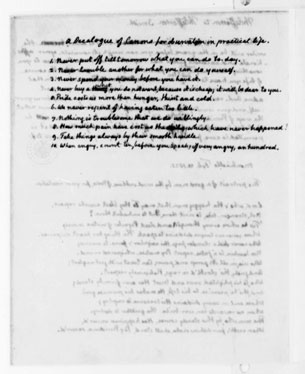
JEFFERSON’S RULES: Browsing through the Thomas Jefferson Foundation’s excellent on-line Thomas Jefferson Encyclopedia, I came across something I hadn’t seen before, Thomas Jefferson’s “Canons of Conduct,” a list of axioms for personal behavior.
Jefferson's Decalogue of Canons (Library of Congress)

Jefferson sent versions of the list to his children and grandchildren; the entry in the TJ Encyclopedia—written by SM Newsletter subscriber Anna Berkes, the research librarian at Monticello’s Jefferson Library who manages the Encyclopedia—includes a reproduction of one of the lists from a letter Jefferson sent to his granddaughter Cornelia Jefferson Randolph. To wit:

A DOZEN CANONS OF CONDUCT IN LIFE

1. Never put off to tomorrow what you can do to-day.

2. Never trouble another with what you can do yourself.

3. Never spend your money before you have it.

4. Never buy a thing you do not want, because it is cheap, it will be dear to you.

5. Take care of your cents: Dollars will take care of themselves!

6. Pride costs us more than hunger, thirst and cold.

7. We never repent of having eat[en] too little.

8. Nothing is troublesome that one does willingly.

9. How much pain have cost us the evils which have never happen’d!

10. Take things always by their smooth handle.

11. Think as you please, & so let others, & you will have no disputes.

12. When angry, count 10 before you speak; if very angry, 100.

Jefferson, Berkes writes, “sent a slightly shorter version of the above list to Paul Clay, the son of his friend Charles Clay, in 1817, and a still more refined version in 1825 to John Spear Smith.”  In his 1825 letter, Jefferson listed a “decalogue of canons for observation in practical life.” To wit:

Never put off till tomorrow what you can do to-day.

Never trouble another for what you can do yourself.

Never spend your money before you have it.

Never buy what you do not want, because it is cheap; it will be dear to you.

Pride costs us more than hunger, thirst and cold.

We never repent of having eaten too little.

 Nothing is troublesome that we do willingly.

How much pain have cost us the evils which have never happened!

Take things always by their smooth handle.

When angry, count ten, before you speak; if very angry, an hundred

It’s interesting to note that Thomas Jefferson himself conspicuously did not follow at least two of the Canon items: spending money before you have it and watching his pennies.


As I noted in Saving Monticello, Jefferson loved spending money (that he had—and that he did not have) and wound up over $107,000 in debt when he died. That financial burden forced his family (led by his daughter Martha Jefferson Randolph and grandson Thomas Jefferson Randolph) to sell all of the land they inherited, as well as the furniture and furnishings at Monticello—and then, in 1831, Monticello itself.


EVENTS:  I have just two events in December, as I am now in full-time writing mode on  my next book, a biography of Barry Sadler, the U.S. Army Sergeant who wrote and performed “The Ballad of the Green Berets.” The pub date is November of 2016.


  • Tuesday, December 1 – book signing (of all of my books) at the Williamsburg, Virginia DAR Chapter’s annual Holiday Bazaar event at Colonial Country Club.
  • Thursday, December 10 – a talk on Saving Monticello for the Hanukkah Program at the Pentagon Chapel in Washington, D.C.

If you’d like to arrange an event for any of my books, email marc527psc@aol.com  For more details on upcoming events, go to http://bit.ly/SMOnline, the “Author Events” page on my website, www.marcleepson.com

Facebook, Twitter: If you’re on Facebook, please send me a friend request. If you’re on Twitter, I’d love to have you as a follower.

Gift IdeasIf you would like a personally autographed, brand-new paperback copy of Saving Monticello, e-mail me at Marc527psc@aol.com

Or go to http://marcleepson.com/signedbooks.html to order copies through Second Chapter Books in Middleburg, Virginia. We also have copies of Desperate Engagement, Flag, Lafayette, and What So Proudly We Hailed. 


Monday, November 2, 2015

November 2015

Saving Monticello: The Newsletter

The latest about the book, author events, and more

Newsletter Editor - Marc Leepson


Volume XII, Number 11                                                                    November 1, 2015


URIAH LEVY’S GIFT: I recently came across an excellent on-line article on the history of the statue of Thomas Jefferson that Uriah Levy commissioned in 1833 that today is the only privately donated statue in Statuary Hall in the Rontuda of the U.S. Capitol.

The article, by Linda Tederick, Assistant Curator at The White House, has great images and uses Saving Monticello as one of its main sources.It tells the entire story of how Uriah Levy commissioned the statue (from the famed French sculptor Pierre-Jean David d'Angers in Paris in the fall of 1832) and how it wound up in the Capitol—focusing, naturally, on the time that it was displayed on the White House lawn.  


As I noted in the book Levy was in Paris taking time off from his U.S. Navy duties. He paid a visit to the 75-year-old Marquis de Lafayette, who had been a close friend of Jefferson’s since they met in Richmond during the Revolutionary War. Lafayette, who died in 1834, loaned Levy a portrait of Jefferson by the American painter Thomas Sully, which David used as his model for Jefferson's face.

Levy stayed in Paris until David completed the statue early in 1834. It stands seven-and-a-half feet tall and depicts Jefferson holding a quill pen in his right hand. In his left is an etched, word-for-word copy of the Declaration of Independence, complete with signatures, including the large “John Hancock.” Behind him are two large books, topped with a laurel wreath. The statue was cast in bronze, and Levy shipped both the finished statue and the plaster mold used to cast it to the United States.

On February 6, 1834, he presented the painted plaster model to the City of New York. The statue was placed on the second floor of the Rotunda at City Hall. It was moved into the ornate City Council Chamber in the 1950s where today it is the only piece of sculpture in a room filled with oil portraits.

A month after he gave the model to New York City, Uriah Levy presented the bronze Jefferson to the nation. He had the words “Presented by Uriah Phillips Levy of the United States Navy to his fellow citizens, 1833,” etched on one side of the statue's bronze base. It was displayed inside the Capitol, in the Rotunda.


Sometime during the James K. Polk administration (1845-1949) the statue was removed from the Rotunda. It was shipped up Pennsylvania Avenue to the White House where, with the permission of President Polk, it was placed on the grounds on the north side facing Lafayette Park. The photo above was taken around in the 1860s. It remained there until 1874 when the statue was cleaned up (it had suffered badly from exposure to the elements) and moved into National Statuary Hall in the Capitol Rotunda, where it stands today.


TEEN-AGED MARTHA: A new cache of letters, including a group of previously private missives written by Martha Jefferson Randolph, Thomas Jefferson’s oldest daughter who lived at Monticello with her eleven children and inherited the place after her father died in 1826. The letters were written when Martha she was in Paris while her father was U.S. Minister to France (1784-89). They recently have been leant to the Thomas Jefferson Foundation—the folks who own and operate Monticello—by a group of Jefferson descendants.


You can read the letters—and many other documents—on the “Jefferson Quotes and Family Letters” page on the Monticello web site at http://tjrs.monticello.org

Other documents in this collection were compiled by Martha Randolph’s granddaughter Martha Jefferson Trist Burke. They include descriptions and reminiscences about the cabin of John and Priscilla Hemmings, who were enslaved at Monticello. That material has helped Foundation’s Curatorial Department interpret and present that space.


EVENTS:  I have four events in September, as I continue researching my next book, a biography of Barry Sadler, the U.S. Army Sergeant who wrote and performed “The Ballad of the Green Berets.” The pub date is November of 2016.


  • Saturday, November 7 – A talk on the Marquis de Lafayette, and book signing for the Henry Clay DAR Chapter in Annandale, Virginia
  • Saturday, November 14 – A talk on Saving Monticello for the Providence DAR Chapter in Fairfax City, Virginia.
  • Thursday, November 19 – A talk and book signing at the Glen Allen Branch Library, 10501 Staples Mill Rd., Glen Allen, Va. on Lafayette. The event is free and open to the public. For info, call 804-290-9500.
  • Friday, November 20 – A talk on the writing process for the Vintage Ladies of Northern Virginia, in Brunswick, Maryland
  • Saturday, November 21 – A talk on Lafayette and book signing for the Colonel William Grayson SAR Chapter in Haymarket, Virginia.

If you’d like to arrange an event for any of my books, email marc527psc@aol.com  For more details on upcoming events, go to http://bit.ly/SMOnline, the “Author Events” page on my website, www.marcleepson.com

Facebook, Twitter: If you’re on Facebook, please send me a friend request. If you’re on Twitter, I’d love to have you as a follower.

Gift IdeasIf you would like a personally autographed, brand-new paperback copy of Saving Monticello, e-mail me at Marc527psc@aol.com

Or go to http://marcleepson.com/signedbooks.html to order copies through Second Chapter Books in Middleburg, Virginia. We also have copies of Desperate Engagement, Flag, Lafayette, and What So Proudly We Hailed.