Saturday, October 5, 2019

October 2019


Saving Monticello: The Newsletter
The latest about the book, author events, and more
Newsletter Editor - Marc Leepson

Volume XVI, Number 10                                                   October 1, 2019

The study of the past is a constantly evolving, never-ending journey of discovery.” – Eric Foner

SUCCESSIVE PARTIES OF VISITORS: Jefferson Levy, who owned Monticello from 1879 until he sold it to the Thomas Jefferson Memorial Foundation in 1923, lived in New York City and was active in the state Democratic Party. He would go on to serve three terms as a U.S. Congressman from lower Manhattan from 1899-1910 and 1911-1915.


When Levy gained control of Monticello, the house and grounds were in terrible condition—as evidenced by the Saving Monticello cover image, the oldest-known photo of the Jefferson’s house, from around 1870. In 1879, Levy hired an on-site superintendant, a man named Thomas Rhodes, and began extensive restorations. By the summer of 1880, they had made enough progress repairing and restoring the place that Jefferson Levy felt comfortable inviting friends and relatives to visit Jefferson’s mansion.

As I noted in Saving Monticello, a Washington Post columnist in June 1880 wrote that Levy was “restoring the interior of the irregular old Monticello mansion and will make it both in finish and furniture as nearly what it was in Mr. Jefferson’s time as possible.” Levy “will begin this week a series of entertainments to his friends, as he intends having successive parties of visitors throughout the summer.”

Those entertainments continued for the next forty-three years. In the book I chronicle some of the many visits of dignitaries, politicians and others to Monticello during that time. I just learned—while delving into the New York Public Library’s digital archives—that in 1882, Levy invited the former Democratic governor of New York Samuel J. Tilden, to be his guest at Thomas Jefferson’s “Essay in Architecture.”

Six years earlier Tilden had been on the losing end of the bitterly contested and hotly controversial presidential election of 1876. He won the popular vote, but came up one electoral vote short of winning the race because of disputed votes in four states. A special, fifteen-member congressional commission of eight Republicans and seven Democrats was set up to decide the issue. The commission voted along party lines, with Tilden thereby losing the election to Rutherford B. Hayes as a result of an eight-to-seven vote.

In a letter Levy wrote to Tilden on July 12, 1982 (below), he invited his fellow Democrat, in the name of party unity (and the spirt of Thomas Jefferson), to come South for some R&R.


In the letter, Jefferson Levy alludes to the disputed election, telling Tilden that he was “the choice in 1876 of the people and Democracy….”  Then Levy puts in a plug for Jeffersonian Democracy, telling Tilden that his “whole desire is to extend to you the pleasure of visiting the Home of the Author of the political doctrines you profess.” He proposed a visit “any time in the fall.”

Tilden (below) politely declined on December 19. In much clearer handwriting, by the way, he wrote:
 “It would afford me great delight to see the home of Jefferson, but I have not been able to find an opportunity, and have, reluctantly, given over the hope of doing so during the present season.”


THE CHAPEL IN THE WOODS: I have done more than two hundred talks on Saving Monticello since it came out early in November of 2001. The one I did on Saturday, September 21, at Kol Ami Congregation in White Plains, New York, turned out to be one of the most memorable.

I was very grateful to Rabbi Shira Milgrom for inviting me to come up to do the talk for that day’s Shabbat Morning Lift, an informal gathering that starts with coffee and bagels and often includes a guest speaker. After the talk the Rabbi leads an “informal and participatory” Shabbat service.

What made this even more special was that Harley Lewis and her late husband Dick thought up the Second Lift concept years ago. As most SM newsletter readers know, Harley Lewis, a great grandniece of Jefferson Levy, kindly provided me with a ton of primary-source material and invaluable advice when I was doing the research for the book in 1999 and 2000. And she has been an enthusiastic supporter of the book and my work ever since.


My wife Janna and I had dinner Friday evening as the guests of one of Harley’s sons, Tom Lewis, and his wife Debbie (in the photo above with Harley and me). They couldn’t have been more welcoming and hospitable. I spoke to Harley on the phone that evening and we made plans to meet after the talk on Saturday.

I was bowled over when Harley arrived during the coffee hour and stayed to take in the talk. I hadn’t seen her since the dedication of the Uriah Levy statue at Congregation Mikve Israel in Philadelphia in 2011, when we both took part in the festivities.

Another special thing about the talk was the venue, the serene and beautiful Chapel in the Woods on the Kol Ami campus. And what made the weekend even more special was that we learned on Saturday that one of Harley’s grandchildren and his wife had her first great-grandchild the day before. The child, descended directly from Uriah Levy’s great grandfather Dr. Samuel Nunez, is a tenth-generation American.     


EVENTS: I have four in October, three of them on Saving Monticello:

F    Friday, October 4. I will kick off the 22nd Annual Conference on the Art and Command of the Civil War sponsored by the Mosby Heritage Area Association, a local historic preservation group in Middleburg, Virginia, where I live. My talk will be on my only Civl War book, Desperate Engagement, which is about the July 1864 Battle of Monocacy and Confederate Gen. Jubal Early’s subsequent attack on Washington, D.C., the subject of the three-day conference. Some tickets remain. For all the details, go to http://bit.ly/MHAATalk

Friday, October 11. A talk on Saving Monticello at the U.S. Naval Academy’s Commodore Levy Chapel following the 7:00 p.m. Oneg services. The event is free and open to the public, but because of security at the Academy, visitors must register in advance. For info on that, contact the Friends of the Jewish Chapel at the USNA in Annapolis at 410-268-0169, email info@fojcusna.org

Saturday, October 12. A talk on Saving Monticello and book signing at the monthly luncheon meeting of the SAR George Washington Chapter in Alexandria, Virginia.

·        Friday, October 25. My third talk of the month on Saving Monticello, as the Keynote Speaker at the annual Southern Jewish Historical Society conference in Charlottesville, Virginia. For info conference, including how to register, go to http://bit.ly/SJHSConf


There’s always the chance that I may have a last-minute talk or signing. For the latest on that, or to check out my scheduled 2019 events, go to the Events page on my website at http://bit.ly/Eventsandtalks

If you’d like to arrange an event for Saving Monticello, or for any of my other books, feel free to email me. For info on my latest book, Ballad of the Green Beret, go to http://bit.ly/GreenBeretBook

GIFT IDEAS:  Want a personally autographed, brand-new paperback copy of Saving Monticello? Please e-mail me at marcleepson@gmail.com  I also have a few as-new, unopened hardcover copies, along with a good selection of brand-new copies of my other books.

Photo credit: Monticello image: The Miriam and Ira D. Wallach Division of Art, Prints and Photographs: Print Collection, The New York Public Library. “Residence of Thomas Jefferson.” The New York Public Library Digital Collections. 1820. http://bit.ly/Montpic

Wednesday, September 4, 2019

September 2019


Saving Monticello: The Newsletter
The latest about the book, author events, and more
Newsletter Editor - Marc Leepson


Volume XVI, Number 9                                                         September 1, 2019

The study of the past is a constantly evolving, never-ending journey of discovery.” – Eric Foner

ELEGANT & DIGNIFIED COUNTRY HOME: A couple of weeks ago, as I was working on my next book—a house history of Huntland, a historic country estate in Middleburg, Virginia—I came across the fact that when the place sold in 1927, a Realtor name H.W. Hilleary helped arrange the settlement. That name might ring a bell if you’ve read Saving Monticello. That’s because in 1919, Jefferson Levy chose Hilleary as his real estate broker when he decided to sell Monticello.

Hilleary started marketing Monticello in April 1919 (asking price: $500,000) with newspaper and magazine advertisements and with an elaborate sales brochure. One of the many joys of doing the research for the book came when I sat down at the Monticello research department about twenty years ago with a copy of that brochure.


It’s an old-fashioned, elaborate piece that includes the text of Thomas Jefferson’s first Inaugural Address and an essay on his monumental political career. On the last page Hilleary makes a discreet sales pitch, quoting an “eminent Frenchman”—undoubtedly the Marquis de Lafayette, who paid a visit to Monticello during his 1824-25 Farewell tour.

Monticello, Lafayette said, “is infinitely superior to any of the houses in America from point of taste and convenience and deserves to be ranked with the most pleasant memories of France and England.”
In 1919 Hilleary also sent a prospecting letter to upper-crust individuals around the country. It read, in part: “You are familiar, I am sure, with ‘Monticello,’ in the beautiful County of Albemarle, near the University of Virginia…. This historic home, this architectural gem, this most picturesque estate, I have the privilege of offering.

“The present owner, for sentimental and other reasons, has never consented to part with it. I am allowed now to bring it to the attention of those who can appreciate and are able to own a property of such distinction and merit. If interested, I shall be glad to give you detailed information and to quote the authorized price.”

Hilleary sent one of the letters to William Summer Appleton, the founder of the Society for the Preservation of New England Antiquities in Boston, and one to Sidney Fiske Kimball at the Archaeological Institute of America. Kimball, who had taught architecture at the University of Virginia, was nationally recognized as the foremost expert on Thomas Jefferson’s architecture. Kimball and Appleton declined Hilleary’s offer.

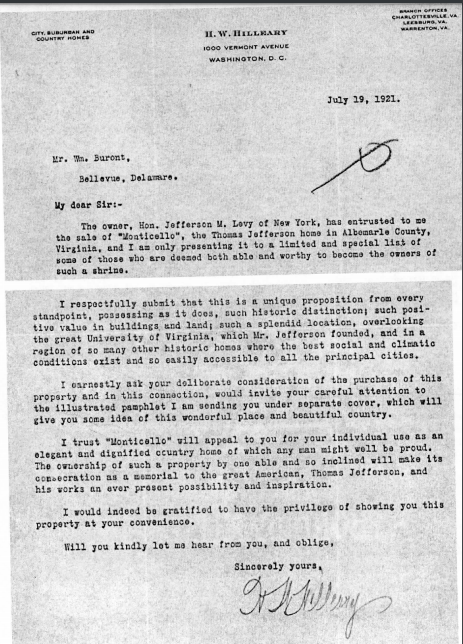
Two years later, Hilleary came up with a second, longer marketing letter, which he mailed along with the brochure to potential buyers. He wrote, in part: “I am only presenting [Monticello] to a limited and special list of some of those who are deemed both able and worthy to become the owners of such a shrine.

I respectfully submit that this is a unique proposition from every standpoint, possessing as it does, such historic distinction; such positive value in buildings and land; such a splendid location, overlooking the great University of Virginia, which Mr. Jefferson founded, and in a region of so many other historic homes where the best social and climatic conditions exist and so easily accessible to all the principal cities.

I trust ‘Monticello’ will appeal to you for your individual use as an elegant and dignified country home of which any man might well be proud. The ownership of such a property by one able and so inclined will make its consecration as a memorial to the great American, Thomas Jefferson, and his works an ever present possibility and inspiration. I would indeed be gratified to have the privilege of showing you this property at your convenience.”

In my Huntland research I found a copy of that letter that Hilleary sent on July 21, 1921, to William du Pont, Sr. (1855-1928), a grandson of E.I. du Pont de Nemours, the founder of the world’s largest chemical company. No doubt du Pont was on Hilleary’s list because in 1900 he had purchased Montpelier, the Central Virginia home of another Founding Father, James Madison. William du Pont also owned large estates in Wilmington, Delaware, and near Brunswick, Georgia. A few years ago, I learned that a copy of that letter also went to Thomas S. Walker, a big Minnesota timber baron and one of the wealthiest men in the country.

Here’s a screenshot of a digital copy of the letter that I found in the William de Pont papers, which are housed in the Manuscripts and Archives Department of the Hagley Museum and Library. The Hagley is located in Wilmington, Delaware, along the Brandywine River on a 235-acre site where E.I. du Pont built a gunpowder factory in 1802


Oddly, the letter is addressed to “Mr. Wm. Buront.” There is no record that Mr. Buront—or Mr. du Pont—replied. Two-and-a-half years later, Hilleary sold Monticello to the newly formed Thomas Jefferson Memorial Foundation, which continues to own and operate Monticello today.

NUMBER 9, NUMBER 9: As I posted on my Facebook page last week, I was very happy (and a bit humbled) to learn that Saving Monticello has just gone into its 9th printing in paperback at the University of Virginia Press. The hardcover (from Free Press at Simon & Schuster) came out in 2001, but went out of print after three printings a few years later. U-Va. Press came out with the paperback in 2003. My thanks to everyone who has supported the book over the years.

EVENTS: I’m still in all-but full-time writing mode for the Huntland book, and have just one event in September.

On Saturday, September 21, I will be doing a “Shabbat Lift” talk on Saving Monticello at follow morning services at Congregation Kol Ami in White Plains, New York. The event is free and open to the public.

I’m particularly excited about this talk because Harley Lewis—Jefferson Levy’s great grandniece who helped me more than anyone as I researched and wrote the book—will be in the audience in this, her synagogue.

For more info, go to http://bit.ly/KolAmiMonticello or email alisonadler@nykolami.org  


There’s always the chance that I may have a last-minute talk or signing. For the latest on that, or to check out my scheduled 2019 events, go to the Events page on my website at http://bit.ly/Eventsandtalks

If you’d like to arrange an event for Saving Monticello, or for any of my other books, feel free to email me. For info on my latest book, Ballad of the Green Beret, go to http://bit.ly/GreenBeretBook

GIFT IDEAS:  Want a personally autographed, brand-new paperback copy of Saving Monticello? Please e-mail me at marcleepson@gmail.com  I also have a few as-new, unopened hardcover copies, along with a good selection of brand-new copies of my other books.

Monday, August 12, 2019

August 2019


Saving Monticello: The Newsletter
The latest about the book, author events, and more
Newsletter Editor - Marc Leepson

Volume XVI, Number 8                                                         August 1, 2019

The study of the past is a constantly evolving, never-ending journey of discovery.” – Eric Foner


A DARK AND PIERCING EYE:Uriah P. Levy was an intelligent, ambitious, tempestuous, bold, extravagant, physically powerful man who was a success in virtually every endeavor he undertook.”

That’s as close as I came in Saving Monticello to a physical description of the first member of the Levy family to own (and save) Thomas Jefferson’s iconic home. I figured that the cropped, head-and-shoulders detail from the full-length portrait of Uriah Levy that we reproduced in the book would speak for itself in that regard.


Plus, I hadn’t found any letters or newspaper or magazine articles or any other primary sources that described the man. So I was pleasantly surprised that a recently digitized April 1834 Boston Post article written by its Washington correspondent about UPL’s donation of the bronze statue of Thomas Jefferson to the nation contains a capsule description of the then U.S. Navy lieutenant, including several physical characteristics.

After providing details about Levy’s donation of the statue, the correspondent rhetorically asked: “Who, you will ask, is the donor?” He answered by writing that Levy “was a native of Philadelphia, and a resident of Virginia.” Levy actually resided in New York City, but was just about to buy Monticello from its then owner, James Turner Barclay. Uriah Levy bought the place to use as a second home, and as a reflection of his admiration for Thomas Jefferson.  

The correspondent then felt he had to let people know Uriah Levy’s religion, writing that he “is a descendant of the Maccabees, and a countryman of Isiah,” his way of saying that Levy was Jewish.
The article went on to say that UPL was “known as a valiant officer, and an accomplished gentlemen.” Then came the first contemporary physical description I’ve seen: “He is about the middling height, say 5 feet 9—finely proportioned, dark complexion, with nothing very peculiar in his countenance but a dark and piercing eye.”


The article—that’s its last paragraph above—guessed Levy’s age as “apparently from thirty-seven to forty.” He actually was about to turn 42, having been born on April 22, 1792.

The long last sentence’s tone struck me as something of an Early Republic echo of the current national debate over immigration. The correspondent says that because of what he called Uriah Levy’s “so much of foreign accent” from spending and mustache, Levy “would not be taken for an American,” but his sterling qualities give him an “undisputed claim to American birth and citizenship.”

That and the fact that he was born in Philadelphia—and was a fifth-generation American.

THIS JUST IN: I found that Boston Post article on the Library of Congress’ Chronicling America page, a regularly updated historical newspaper database that’s searchable at  https://chroniclingamerica.loc.gov

As I was searching “Uriah Levy” from 1834-79, I also came across the first newspaper article I’d ever seen announcing the news that Jefferson Monroe Levy, UPL’s nephew, had bought out the other heirs to his uncle’s estate and purchased Monticello on March 20, 1879.

The clipping below is the entire article from the Richmond Dispatch of March 21, 1879, the day after J.M. Levy ended seventeen years of legal wrangling among his uncle’s wife, his siblings and their spouses, and his nieces and nephews over the terms of his will.


The will left Monticello to the people of the United States to be used as an agricultural school for the orphans of Navy warrant officers. That didn’t go over well with the heirs, who filed two petition lawsuits (in New York and Virginia) that eventually went to the Supreme Courts of both states. Finally, in 1879, the courts ruled that Monticello should be auctioned off.

In the interim, Jefferson Levy had purchased the Monticello inheritance shares from some of the other heirs, including Uriah’s widow, Virginia Lopez Levy Ree; her new husband William J. Ree; Jefferson Levy’s mother and father, Jonas P. and Fanny Levy; and Virginia Ree’s brother George Washington Lopez of Spanishtown, Jamaica.  

While Jefferson Levy did, indeed, repair the place, he never turned it into a “summer resort,” as the article predicted.

EVENTS: I’m still in all-but full-time writing mode for my next book, and won’t have another event for any of my books in August.

On Saturday, September 21, however, I will be doing a “Shabbat Lift” talk on Saving Monticello at Congregation Kol Ami in White Plains, New York. The event is free and open to the public.
I’m particularly excited about this talk because Harley Lewis (Jefferson Levy’s great grandniece), who helped me more than anyone as I researched and wrote the book, will be in the audience in this, her synagogue. For more info, go to http://bit.ly/KolAmiMonticello or email alisonadler@nykolami.org  

There’s always the chance that I may have a last-minute talk or signing. For the latest on that, or to check out my scheduled 2019 events, go to the Events page on my website at http://bit.ly/Eventsandtalks

If you’d like to arrange an event for Saving Monticello, or for any of my other books, email me. For info on my latest book, Ballad of the Green Beret, go to http://bit.ly/GreenBeretBook


GIFT IDEAS:  Want a personally autographed, brand-new paperback copy of Saving Monticello? Please e-mail me at marcleepson@gmail.com  I also have a few as-new, unopened hardcover copies, along with a good selection of brand-new copies of my other books.

Saturday, July 6, 2019

July 2019


Saving Monticello: The Newsletter
The latest about the book, author events, and more
Newsletter Editor - Marc Leepson

Volume XVI, Number 7                                                         July 1, 2019

The study of the past is a constantly evolving, never-ending journey of discovery.” – Eric Foner

URIAH LEVY’S DEEDS: If you’ve ever been to downtown Norfolk, Virginia, chances are you’ve driven by—if not visited—the striking Hampton Roads Naval Museum, which sits on the Elizabeth River and includes the massive, World War II battleship, the U.S.S. Wisconsin.  

I just learned through a new posting on the museum’s website that the museum has in its collection a much (much) smaller Navy object that I had not known existed:

A julep silver cub that Uriah Levy received after he came home from the War of 1812—having been imprisoned along with the rest of the crew of his chip, The Argus—in England for sixteen  months.


The cup (below) is engraved with Levy’s initials, along with a Latin inscription, Dant Facta Hanc Coronam (“Deeds gave this crown). As I wrote in Saving Monticello, Jefferson M. Levy had that motto emblazoned—along with a French-style coat of arms of two laurel sprays enclosing the letter “L”—on the headboard of a bed in one of the upstairs rooms at Monticello that JML used as a dressing room and clothes closet.


 Hampton Roads Naval Museum educator Alicia Pullen, who wrote the excellent post, correctly notes that neither the motto nor the crest appears “in either Levy’s maternal or paternal line, which suggested that Uriah Levy may have created the insignia to celebrate his 1814 release from English military prison.”  

The base of the cup, she points out, is engraved with the date “1814, likely celebrating Levy’s return home.”  

Her post goes on to briefly recount UPL’s post-1814 Navy career (he died in service in 1862), noting that his promotion to Captain in 1844 was “uncommon in the Navy, having started as a cabin boy [on a merchant ship] and promoted to captain.” She also talks about the antisemitism he faced in the Navy and Uriah Levy’s ultimately successful campaign to end flogging.

Pullen notes that perhaps Levy’s “most significant contribution to the American people” was his “effort to preserve, conserve, and repair President Thomas Jefferson’s home at Monticello.”  

And she goes on to mention that UPL’s nephew Jefferson Levy took control of the property in 1879 after it went into a second period of decline. Her conclusion is right on the mark: “The Levys’ efforts in restoring one of the nation’s most notable historic landmarks demonstrated their devotion and understanding for historic preservation as a way of maintaining the legacy of its leaders and the past.”

You can read the entire post—which includes a reference to Saving Monticello—at http://bit.ly/UriahCup


EVENTS: I’m still in seven-day-a-week writing mode for my next book, and won’t have another public event for any of my books in July.  


There’s always the chance that I may have a last-minute talk or signing, though. For the latest on that, or to check out my scheduled 2019 events, go to the Events page on my website at https://leepsoncalendar.blogspot.com

If you’d like to arrange an event for Saving Monticello, or for any of my other books, email me. For info on my latest book, Ballad of the Green Beret, go to http://bit.ly/GreenBeretBook

GIFT IDEAS:  Want a personally autographed, brand-new paperback copy of Saving Monticello? Please e-mail me at marcleepson@gmail.com  I also have a few as-new, unopened hardcover copies, along with a good selection of brand-new copies of my other books.


Friday, June 7, 2019

June 2019


Saving Monticello: The Newsletter
The latest about the book, author events, and more
Newsletter Editor - Marc Leepson

Volume XVI, Number 6                                                         June 1, 2019

The study of the past is a constantly evolving, never-ending journey of discovery.” – Eric Foner

DEPREDATIONS: Much of what I learned that formed the heart of Saving Monticello came from a myriad of  first-person accounts about the state of the house and its grounds before, during, and after Uriah Levy and his nephew Jefferson Levy owned Thomas Jefferson’s “Essay in Architecture.”

In the last several years, as oceans of newspapers and magazines, official records, and memoirs have been digitized, I’ve uncovered a small stream of hitherto all-but-hidden primary-source evidence dealing with 19th century visits to Monticello Mountain.


I’ve learned some new facts from these sources, but they mainly serve to buttress what I concluded and wrote in the book, that the Levy family repaired, preserved, and restored—that is, they saved—Monticello on two different occasions: 1834-1862 for Uriah, and 1879-1923 for Jefferson M.
That’s the case with a new (to me) account I just discovered of a South Carolina newspaper correspondent’s vist to Monticello in the spring of 1896, twenty-four years into Jefferson Levy’s ownership.

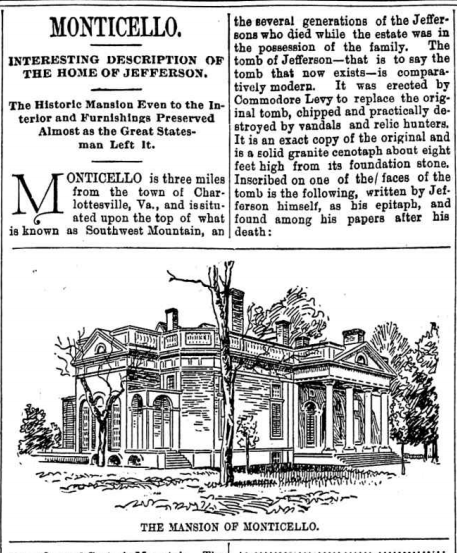
Titled “Monticello: Interesting Description of the Home of Jefferson,” the long, detailed article appeared in at least two S.C. newspapers, the Abbeyville Press and Banner on April 29, 1896, and the Edgewater Advertiser on May 20 that year.

It included an evocative line drawing of the house (above) and a sub-headline that jibes with virtually everything else we know about the Levys’ stewardship of Monticello:

“The Historic Mansion Even to the Interior and Furnishings Preserved Almost as the Great Statesman Left It.”

Well, not almost as Jefferson left it. But Jefferson Levy had done a remarkable job of restoring Monticello by 1896, seventeen years after he bought out Uriah’s other heirs and took control of Monticello. which had fallen into terrible condition during seventeen years of legal wrangling over UPL’s will following his death in 1862.

Our unidentified correspondent was impressed with just about everything he saw. He got his “first glimpse” of the house, he wrote, after reaching the top of the mountain and checking in at the old brick Porter’s Lodge. The visitor drove past the lodge and through an open “iron gateway of modern design,” then rang “the old plantation bell, which announces to the people at the mansion that guests are coming.” The “people” in this case were Jefferson Levy’s superintendent Thomas Rhodes, who moved to Monticello in 1889 to oversee the repairs and restoration of the house and grounds—and his staff.

Rhodes, the writer said, “occupies the old overseer's house, a substantial stone structure just opposite the entrance to the great lawn.” His workers at Monticello were “several colored people, one or two of t claiming to be descendants of Jefferson’s servants.” He very likely was referring to the long-time gatekeeper, Willis Shelton (1835-1902), and to Shelton’s grandson Willis Henderson (1885-1966), who was born at Monticello and worked for Jefferson Levy as a cook and house guide.

Arriving at the house, the correspondent reported that the lawns and shrubbery were “admirably kept, the stone walls and fences are radiant with new whitewash, the old quarters of the house servants are as clean and white as paint can make them and the mansion itself is carefully watched and the least evidence of decay repaired at once.”


The interior, he correctly reported, “has never been disturbed in its arrangement by any of the Levy family. On the contrary, so far as possible, they have endeavored to preserve, even in the furnishings of the house, as much of a similarity to the old furniture as possible.”

He then goes on to describe the interior of the house room-by-room, and gives an expansive tour of the grounds. The correspondent ends with a lament for Thomas Jefferson’s dire fiscal straits, which resulted in him passing on nothing but debt to his family when he died.
Despite “all of the magnificence with which he was surrounded, not withstanding the emoluments of his public career, he died, as the world knows, a poor man, and worse than poor, for he was hopelessly in debt.”

EVENTS: I’m continuing my seven-day-a-week writing mode for my next book, and have just a two June events.

The first is on Friday, June 7 in the historic town of Hillsboro, Virginia, where I will be taking part in a 50th anniversary commemoration called “Woodstock in the Gap,” a two-day event including music, food, local beers and wines—and more. My topic: Woodstook and the Vietnam War. I attended the former and took part in the latter. In fact, I had only been out of the Army for about a month when we trekked up to New York for what we thought was going to just another big rock music festival. Info at http://bit.ly/WoodstockHillsboro

On Saturday, June 8, I’ll be doing a talk on Saving Monticello and book signing at the 40th anniversary luncheon of the Cameron Parish DAR chapter in Reston, Virginia.

Also, I’ll be doing a talk on my Francis Scott Key bio, What So Proudly We Hailed, on Tuesday, July 2, in Washington, D.C. for Pints and Profs at La Pop cultural salon in Adams Morgan. Details to come at http://bit.ly/ProfsJuly2


There’s always the chance that I may have a last-minute talk or signing. For the latest on that, or to check out my scheduled 2019 events, go to the Events page on my website at https://leepsoncalendar.blogspot.com

If you’d like to arrange an event for Saving Monticello, or for any of my other books, email me. For info on my latest book, Ballad of the Green Beret, go to http://bit.ly/GreenBeretBook

GIFT IDEAS:  Want a personally autographed, brand-new paperback copy of Saving Monticello? Please e-mail me at marcleepson@gmail.com  I also have a few as-new, unopened hardcover copies, along with a good selection of brand-new copies of my other books.

Sunday, May 5, 2019

May 2019


Saving Monticello: The Newsletter
The latest about the book, author events, and more
Newsletter Editor - Marc Leepson

Volume XVI, Number 5                                                         May 1, 2019

The study of the past is a constantly evolving, never-ending journey of discovery.” – Eric Foner


GRADE CHANGE: I owe H.C., a mid-19th century New York Times reporter, an apology. In last month’s newsletter, I called him out for writing in March 1866 that Monticello was “a copy of a building Mr. Jefferson saw in Paris, which struck his fancy.”

That statement, I said, was not true.

As I explained it:
“Monticello is not a copy of any one structure. For one thing [Thomas Jefferson], designed and built two houses at Monticello—tearing down most of the first one. For another, he was most influenced by the 16th century Italian architect Andrea Palladio—not by a building he saw in Paris.”
My conclusion: “H.C. gets a D-minus for his knowledge of Monticello’s architectural history.”

I was wrong about that, as I was reminded by my friend Susan Stein, Monticello’s curator, and by my colleague Rick Britton, an esteemed historian in Charlottesville, both long-time subscribers to this newsletter. As Susan gently told me: the second version of Monticello, the “revision,” was “much influenced by several buildings that [Jefferson] saw in France, especially l’Hôtel de Salm, for its one-story appearance and dome. The influence of French neo-classical architecture on [Monticello’s] later design is widely recognized.”

Rick emailed to say the same thing, pointing me to the page on the Thomas Jefferson Foundation’s website that goes into Jefferson’s architectural influences in detail: http://bit.ly/MonticelloDesign
And Susan sent me this image which shows a side-by-side comparison.


So, with apologies to readers, I stand corrected. I hereby raise H.C.’s grade to a B-minus, because I’m an exacting grader and he failed to mention the exact Parisian building that Jefferson saw in Paris, l’Hôtel de Salm.

Said building, by the way, is a magnificent one, inside and out. It’s on the Left Bank facing the Tuileries Gardens. It was completed in 1787 for the German Prince Frederick III (aka the Prince of Salm-Kyrburg), and became the Palais de la Légion d’Honneur in 1804 (during Jefferson’s first term as president) under Napoleon Bonaparte.

l’Hôtel de Salm suffered severe damage in an 1871 fire, but seven years later was rebuilt with the same facades. Today it remains the home of the Legion of Honor, aka la Grande Chancellerie de la Legion d’Honneur.  The website is: http://bit.ly/HoteldeSalm

EVENTSI’m in seven-day-a-week writing mode on my next book, and have just two events in May. Both are talks on Saving Monticello. The first is on Monday, May 5, for a retiree group in Charlottesville, one of my favorite places on earth.

The second will be on Thursday, May 16, in New York City. The American Sephardi Federation is sponsoring it at 7:00 at the Center for Jewish History, 15 West 16th Street. Here’s how the ASF is advertising the talk:
Journalist, historian, and author Marc Leepson will present a lively talk (complete with vintage images) of a little-known but important part of Sephardic Jewish-American history and American historic preservation: how U.S. Navy Commodore Uriah P. Levy and his nephew Jefferson M. Levy—who owned Monticello from 1834-1923—on two occasions repaired, restored, and preserved the Thomas Jefferson's iconic house in Charlottesville, Virginia. 


The talk will include a history of the Levy-Phillips-Nunez Family, one of the most accomplished Jewish-American families of the 18th and 19th centuries. It begins with the arrival in 1733 of Dr. Samuel Nunez, a leader of a group of forty Sephardic Jews who fled Portugal and were among the founders of Savannah, Georgia. It includes the biographies of Uriah Levy (a fifth generation American, born in Philadelphia in 1792, who went on to a distinguished career in the U.S. Navy) and his nephew Jefferson Monroe Levy, who was born in New York City, and became a prominent lawyer, a hugely successful real estate and stock speculator, and a three-term member of Congress. The heart of the story is Uriah and Jefferson Levy's stewardship of Monticello, without which the house very likely would not have survived.

I would love to see my NYC friends at the talk. Ticket info at http://bit.ly/May16TalkNYC

There’s always the chance that I may be doing a last-minute talk or signing. For the latest on that, or to check out my scheduled 2019 events, go to the Events page on my website at https://leepsoncalendar.blogspot.com

If you’d like to arrange an event for Saving Monticello, or for any of my other books, email me. For info on my latest book, Ballad of the Green Beret, go to http://bit.ly/GreenBeretBook

GIFT IDEAS:  Want a personally autographed, brand-new paperback copy of Saving Monticello? Please e-mail me at marcleepson@gmail.com  I also have a few as-new, unopened hardcover copies, along with a good selection of brand-new copies of my other books. 


Thursday, April 4, 2019

April 2019


Saving Monticello: The Newsletter
The latest about the book, author events, and more
Newsletter Editor - Marc Leepson

Volume XVI, Number 4                                                         April 1, 2019

The study of the past is a constantly evolving, never-ending journey of discovery.” – Eric Foner


‘ALMOST A DESERTED RUIN’: In my now twenty-year quest to document the post-Thomas-Jefferson history of Monticello, I continue to find newly digitized first-person accounts of 19th century visits to the mountain. I feel gratified to report that these new (to me) primary sources confirm what I wrote about the condition of the place following Jefferson’s death in Saving Monticello.

The latest case-in-point: An article that appeared in The New York Times on March 11, 1866, about a year after the Civil War ended, a time when Monticello was under the care of cantankerous caretaker Joel Wheeler. During this time, the two partition lawsuits filed by Uriah Levy’s heirs (he had died in 1862) were very slowly wending their way through the courts and the house and grounds suffered greatly under Wheeler’s not-so-benign neglect.

The article, entitled “Affairs in the South,” was written by a special correspondent identified only as a “northern traveler,” and the initials “H.C.,” who was making a reporting tour through the former Confederate states. His stop in Charlottesville contains H.C.’s observations as he and a local acquaintance, Judge Alexander Rives, made their way up to Monticello by foot early in March from Rives’ nearbly home. Qwing to recent wet weather, “the roads were bad.” H.C. said, so the two men “took a stroll up the mountain path to the Heights of Monticello.”


In Jefferson’s time, he writes, “Monticello must have been a delightful residence. Now it is almost a deserted ruin, its occupants being a freedman and his family.” There may have been a former enslaved person and his family at Monticello that day, but it’s all but certain that Joel Wheeler, who was white, was the “occupant” of the house at this time. He would remain living there until Jefferson Levy obtained the property in 1879 from the other heirs, and sent him packing.

H.C. goes on to describe the house as “a very peculiar structure, its architecture being a copy of a building Mr. Jefferson saw in Paris, which struck his fancy.” That simply is not true.

Thomas Jefferson’s Monticello is not a copy of any one structure. For one thing, he designed and built two houses at Monticello—tearing down most of the first one. For another, he was most influenced by the 16th century Italian architect Andrea Palladio—not by a building he saw in Paris. H.C. gets a D-minus for his knowledge of Monticello’s architectural history.

But his newspaper reporting is much more accurate, as it jibes with virtually every other first-person account of Monticello from the same time. For example, he says the terraces were “rapidly falling into decay,” and that the only furnishings he could see in the parlor were “the old clock over the doorway, and a plaster bust of Jefferson covered with dust.”

The lawn, he wrote, was “a field covered with cornstalks and rubbish.” The “musty smell,” he said, “and the deserted look” of the first-floor rooms “forms a sad contrast to the appearance they represented some forty years ago.” After dissing the narrow stairways and the upstairs bedrooms (“about the worst constructed” he’d “ever seen”), H.C. concluded with this gloomy assessment of Monticello: “Everything about the place is rapidly going to decay.”

There was s silver lining, however. The “house itself, being of very substantial build,” he said, “appears to be in good preservation.”


H.C. and Judge Rives left the house and headed toward the family graveyard. Along the way, H.C. reported that the “timber of the mountain woods was being rapidly diminished,” probably by Joel Wheeler.

The Jefferson family cemetery, which H.C. called a “burying-ground,” was “in a disgraceful state.” Its outside walls were “gradually falling to the ground.” Worse—and there are photographs (such as the one above) that bear this out—was the condition of Jefferson’s tombstone.  Over the years visitors helped themselves to chippings from the stone marker.

With the gate unlocked, H.C. wrote, “ingress can be obtained by every vandal curiosity-hunter disposed to desecrate the tomb of Jefferson for the sake of possessing a chip of the stone monument covering his grave.”

 MONTICELLO’S CABINET: In last month’s newsletter I quoted from an 1861 newspaper article in which a Charleston, South Carolina, newspaper correspondent described a recent visit to Monticello. In his description of the interior of the house, the journalist wrote: “The pencil might delineate, but no words can describe, the exquisite charm of this soft cabinet picture.”

I had no idea what “cabinet” meant in that context. But now I do, as an SM newsletter subscriber—my friend and colleague, the author and former Los Angeles Times art critic Cathy Curtis—emailed to fill me in.

“Beginning in the Renaissance, this was the name for small paintings,” Cathy said, “often of an entire figure,    compressed into the space of a square foot or two, that people kept in a small room, or ‘cabinet.’ The master of the house would have such a room as a private study.”


When I checked, I saw that Jefferson did, indeed, have a room (above) that was known as his cabinet. It’s the small-ish office next to his bedchamber on the first floor. You can get a 360-degree panoramic tour of today’s fully furnished cabinet at this page on Monticello’s website: http://bit.ly/MontCabinet

EVENTS: Just one in April, on the 13th for the Pentagon DAR Chapter in Alexandria, Virginia, on my book, Ballad of the Green Beret: The Life and Wars of Staff Sgt. Barry Sadler.

My main event this month—and in the next dozen or so months—will be writing my next book. It’s another house history, this one about Huntland, a historic house and farm in Middleburg, Virginia. It was built in 1837 by William Benton, who supervised the building of Oak Hill, the nearby residence of President James Monroe.

Huntland is on the National Register of Historic Places (http://bit.ly/Huntland), mainly because of what a son of the Gilded Age, Joseph B. Thomas, did after he bought the place in 1911. Thomas, as the National Register designation—written by my colleague, the great architectural historian Maral Kalbian—puts it: “converted and enlarged a relatively modest but stately brick Virginia country dwelling into a Colonial Revival-style masterpiece. At the same time, Thomas… constructed arguably one of the most sophisticated kennels and stables to accommodate horses and hounds associated with point-to-point foxhunting in the region.”

The history of the house in a way parallels that of Monticello, as Huntland went into a steep period of decline in the 1990s and early 2000s, and was saved from ruin, and beautifully preserved and restored, by the current owner, Betsee Parker.

Following a visit to Huntland a few weeks ago

There’s always the chance that I may be doing a last-minute talk or signing. For the latest on that, or to check out my scheduled 2019 events, go to the Events page on my website at https://leepsoncalendar.blogspot.com

If you’d like to arrange an event for Saving Monticello, or for any of my other books,e email me. For info on my latest book, Ballad of the Green Beret, go to http://bit.ly/GreenBeretBook

GIFT IDEAS:  Want a personally autographed, brand-new paperback copy of Saving Monticello? Please e-mail me at marcleepson@gmail.com  I also have a few as-new, unopened hardcover copies, along with a good selection of brand-new copies of my other books.