Friday, June 9, 2023

June 2023


Saving Monticello: The Newsletter

The latest about the book, author events, and more

Newsletter Editor - Marc Leepson


Volume XX, Number 6                                          June 2023

“The study of the past is a constantly evolving, never-ending journey of discovery.” – Eric Foner


IN HALLOWED REPOSE: Visitors to Monticello who take in the fenced-in Jefferson family graveyard about 2,000 feet from the house often presume that the small cemetery conveyed with the property when Jefferson’s heirs sold Monticello. But that is not the case. 

The graveyard, containing Thomas Jefferson’s gravesite and plots of many of his descendants and their families, was retained by the family after they sold Monticello to James Turner Barclay in 1831, five years after his death. The family continued to maintain and preserve the graveyard after Barclay sold Monticello to Uriah Levy in 1834, when Jefferson Monroe Levy took control in 1879, and when he sold the property to the Thomas Jefferson Memorial Foundation in 1923. 

Since 1913, the graveyard has come under the purview of the Monticello Association, a nonprofit founded that year. Most of its members are lineal descendants of Thomas Jefferson. 

Which brings us to a bit of drama surrounding Thomas Jefferson’s grave that I just learned about—although it happened in 1882. I discovered it while searching the Library of Congress’ Chronicling America historic newspaper archive, which contains hundreds of thousands of searchable digitized images of newspapers (mainly, but not exclusively, small and medium-sized city newspapers) from 1770-1963. 

As I was searching for potential material to use in this newsletter, I happened upon a few articles about a kerfuffle instigated in 1882 by Thomas Jefferson’s oldest surviving grandchild, Septimia, so named because she was the seventh (and last) daughter of Thomas Jefferson’s daughter Martha Randolph and her husband Thomas Mann Randolph.  

Septimia Anne Randolph, was born on January 3, 1814, and grew up at Monticello. Not long after Thomas Jefferson died in 1826, she moved to Boston with her mother and younger brother George where she continued her education at the home of her older sister Ellen, who had married Joseph Coolidge and moved north with him to Massachusetts.

Septimia spent the next ten years living with relatives and family friends back home in Virginia, in Washington, D.C., Louisiana, Florida, and in Havana, Cuba. While in Havana, she met a Scottish doctor, David Scott Meikleham. They married on August 13, 1838, at the Randolph family’s Edgehill Plantation near Monticello, then moved to Havana.

The couple settled in New York City, where Dr. Meikleham practiced medicine until his death on November 20, 1849. His early demise was a financial burden to Septimia and her four children. To make ends meet, she ran a boardinghouse, then left New York to return to Edgehill, and then moved to Washington, D.C., where she lived, as one newspaper reported, with three of her “middle-aged” children “in a humble cottage” in Georgetown, “which rents for $20 a month.” She died in Washington at age 73, on September 14, 1887.

Septimia Meikleham (in portrait below) made national headlines in the spring of 1882 when she announced that, as Jefferson’s oldest direct descendant, she’d decided that her grandfather’s remains should be disinterred from the family gravesite on the mountaintop in Charlottesville and reburied in Glenwood Cemetery in Northeast Washington, D.C. Glenwood, not far from the present-day Washington Hospital Center, is the site of the early 19th century Clover Hill Farm, which became a cemetery in 1854 and remains one today.


The reason for the move, Septimia said, was that the Monticello graveyard had “passed out of control of the family” three years earlier, in 1879, when Jefferson Monroe Levy settled a family lawsuit over Uriah Levy’s will and took ownership of the property. That simply was not true as the graveyard never conveyed with the property and remained in the hands of the descendants of her brother, Thomas Jefferson Randolph. Nevertheless, the Glenwood Cemetery Board of Trustees agreed to accept Jefferson’s remains at its June 1882 annual meeting.

The backlash came a few days after the meeting when the heirs of Thomas Jefferson Randolph (who had died in 1875), the co-executor of his grandfather’s will, hired an attorney to oppose the move. The heirs “will not allow Jefferson’s remains to be moved to another cemetery,” the attorney wrote to the Glenwood board. He also pointed out that the graveyard did not convey with the sale of Monticello, and that T.J. Randolph’s heirs—not Septimia—owned and managed the site.  

To his credit, Jefferson Monroe Levy spoke out forcefully against Septimia Meikleham ’s proposal. He was quoted at length in several newspapers giving the history of the graveyard and making it clear he strongly opposed moving the Thomas Jefferson’s remains from the place where he let it be known he wanted to rest in peace.

“The spot where Jefferson was buried was selected by himself,” Levy said, “and there are peculiar reasons why his wishes should be respected. When Jefferson and [his close friend and brother-in-law] Dabney Carr were young men, they made an agreement that whichever of them should die first should be buried by the survivor under a certain oak tree at Monticello, which was a favorite with them both.

“Dabney Carr died in France, in the time of the Revolutionary War, and after the war was over, Jefferson, in accordance with his agreement, had the body of Carr brought to this country and buried under the oak. When Jefferson died, he expressed in his will his desire to be buried in the same secluded spot beside his friend. He also left directions as to the monument to be erected over him.

“His wife and children were buried in the same spot of ground. The Randolph family has used it as burying ground ever since.”


Newspapers throughout the country agreed with the other descendants and with Jefferson Levy, and editorialized against the move, some of them intimating that Septimia pushed for the move for financial gain. The St. Paul (Minnesota) Daily Globe, for example, editorialized on June 18, 1882, that Thomas Jefferson had “the wish that his remains might rest forever undisturbed, and it was only left for modern, mercenary ghouls to prepose to desecrate the hallow burial lot at Monticello.”

The editorial concluded:
“Would it be anything short of sacrilege to remove from ground so hallowed, selected by himself, for any purpose, and especially for a mercenary one, the remains of the venerated patriot, philosopher and statesman? Let the remains rest undisturbed, in hallowed repose, ‘until the last syllable of recorded time.’”

The Glenwood Board took the hint and dropped the matter.

HOUSE HISTORY NO. 2: If you go to the University of Virginia Press Fall 2023 catalog online and scroll down the left side, you’ll get a preview of my next book. Huntland: The Historic Virginia Country House, the Property, and Its Owners, which will be coming out in August. It’s my tenth book and my second house history, along the lines of Saving Monticello. Huntland, in Middleburg, Virginia, was built in 1834, and certainly has lots of history, memorable owners, and a triumphant 21st century historic preservation story. Stay tuned for more details.

Here’s the link for the U-Va. Press Fall Catalog; https://www.upress.virginia.edu/fall23.pdf 

EVENTS: Just one in June, a talk on my only Civil War book, Desperate Engagement, the story of the little-known but crucial July 11, 1864, Battle of Monocacy near Frederick, Maryland, and Confederate Gen. Jubal Early’s subsequent attack on Washington, D.C., that takes place on Saturday, June 17, for the Alexandria (Va.) Civil War Roundtable. 

For details on other upcoming events, check the Events page on my website:  https://bit.ly/NewAppearances 

GIFT IDEAS:  For a personally autographed, brand-new paperback copy of Saving Monticello, please e-mail marcleepson@gmail.com  I also have a few as-new, unopened hardcover copies, along with a good selection of new copies of my other books: Flag: An American Biography; Desperate Engagement; What So Proudly We Hailed; Flag: An American Biography; and Ballad of the Green Beret: The Life and Wars of Staff Sgt. Barry Sadler.


Friday, May 5, 2023

May 2023

Volume XX, Number 5                                   May 2023

“The study of the past is a constantly evolving, never-ending journey of discovery.” – Eric Foner


AN EXCELLENT MAN: As I found out while doing the research for Saving Monticello, Jefferson M. Levy, like his uncle Uriah P. Levy, was a New York City resident who did not live full time at Monticello during the years (1879-1923) that he owned it. But Jefferson Levy did spend considerable amounts of time, including many summer weekends, at Thomas Jefferson’s Charlottesville, Virginia, “Essay in Architecture” during the 44 years when he was its proud owner. 

I recently found more evidence to buttress the fact that Jefferson Levy frequented Monticello regularly, especially in the early twentieth century, in a recently digitized newspaper clipping. It’s contained in one of the massive scrapbooks of clippings of newspaper articles* in which Jefferson Levy (in a 1914 newspaper photograph, right) is mentioned in the archives of the Center for Jewish History. You can browse through them online at https://bit.ly/JMLCollectionCJH 

Said evidence: a brief, kind-of gossipy article in the May 22, 1911, New York Herald, on the occasion of JML’s “return to the halls of Congress.” Levy, an extremely successful lawyer and real estate and stock speculator, had been re-elected to the House of Representatives in the fall of 1910 and took his seat in March 1911. A decade earlier he had served in the House for one term, from 1899-1901, representing New York's 13th Congressional District in Manhattan. 

Levy, a conservative Democrat, would be “an excellent man for his district,” the article predicted, pointing to the fact that he’d had experience on Capitol Hill with his earlier term in the House, and that he therefore knew “the ropes and wires better than a new man.” 

The article went on to say that as proud as he was to be a member of Congress, Jefferson Levy was “prouder yet,” of owning Monticello, which in 1911 he had owned for more than three decades. Keeping up the “reputation for hospitality” that Monticello “enjoyed in Jefferson’s time,” the article noted, Levy “takes down a gay party of his cronies nearly every week-end.” 

I couldn’t help pondering the ironic fact that at the time the article was published and Jefferson Levy was hosting regular jolly parties at Monticello, the ardent Thomas Jefferson devotee Maud Littleton was launching her national campaign to take Monticello from him and turn it into a government-run house museum—a campaign, as I show in Saving Monticello, tainted by the stench of anti-Semitism. 

After resolving that the property should not belong to Jefferson Levy, Maud Littleton spent the first half of 1911 furthering her knowledge of the history of Monticello. That resulted in her writing and publishing “One Wish,” a sixteen-page tract mailed out to influential friends around the country that summer. That emotional plea for an end to the Levy family’s ownership of Monticello was the start of a bitter, contentious, three-year battle between Mrs. Littleton and her allies and Jefferson Monroe Levy and his supporters over who would own Monticello.

The bitterness ended in the fall of 1914 when Jefferson Levy—who once said that he would sell Monticello only when the White House was for sale—agreed to let the government have the house and its 600-plus acres, plus all its furniture and furnishings, for $500,000. That mollified Maud Littleton, but the sale never happened as Congress couldn’t come to grips with the asking price. 

All interest in Monticello on Capitol Hill ended when the U.S. entered World War I in 1917. Five years after the war Jefferson Levy sold Monticello to the newly formed Thomas Jefferson Foundation for his $500,000 asking price. 


*Those big scrapbooks, which I went through page-by-page at the Center for Jewish History archives back in pre-digital days (1999), are made up primarily of newspaper articles in which Jefferson Levy is mentioned. He employed a clipping service, a long-gone, pre-Internet business that searched for and then physically cut out newspaper articles and sent them to clients.

When I started my journalism career in 1974 at Congressional Quarterly we had two full-time people serving as our in-house clipping service. Every day they’d go through scores of daily newspapers with a red pencil searching for topics that the magazine’s and other CQ news services’ reporters were working on and then “clip” them out with a metal ruler and deliver them to us. That low-tech “search engine” had nothing on Google, but it worked very well back in the 1900s. 

MEA CULPA: URIAH LEVY’S WORTH:  In the April issue I mentioned that, as I wrote in Saving Monticello, Uriah Levy was listed as one of the wealthiest men in Manhattan in the 1855 edition of Moses Beach’s The Wealth and Biography of the Wealthy Citizens of the City of New York. And that Beach estimated Levy to be worth $500,000.

I had an email from an attentive newsletter subscriber, Harry Zimmerman, who said that while doing research for a play he is writing about Uriah Levy, he came across the Beach book and saw that the figure was not $500,000, but $250,000. 

I checked my files and he is correct, as you can see from the image of the entry below—although the comma looks like a period and the last zero somehow was dropped. How I managed to double that figure when I wrote the book more than twenty years ago escapes me. But it happened. And if the book ever goes into a second edition, I will correct that error. 


That misstep got me thinking about how much $250,000 in 1855 would be worth today. So I went online and found several inflation calculator websites. I also found out that the sites use educated guesses for pre-1913 inflation figures because the U.S. Bureau of Labor Statistics only began tabulating inflation data in 1913. 

I went to three inflation calculator sites, plugged in $250,000 and 1855, and they all came up with approximately the same figure: that Uriah P, Levy that year was worth the equivalent of more than $8.5 million in 2023. 

THE DOC: Steven Pressman’s great documentary, “The Levys of Monticello,” which was inspired by Saving Monticello, is making its last round of film festivals this spring. Next up is a screening in Brookline, Mass., on May 8 during the National Center for Jewish Film’s annual Film Festival. For info, go to https://bit.ly/ScreeningBoston 


EVENTS: Here are details about my May author events: 

On Tuesday, May 9, I’ll be doing a talk and book signing on the life of Francis Scott Key, based on my book, What So Proudly We Hailed: Francis Scott Key, A Life, at the McLean (Virginia) Historical Society. 

On Tuesday, May 23, the topic will be Saving Monticello for my talk and book signing for the Resident Forum speaker series at the Heritage Hunt Retirement Community in Gainesville, Virginia. 

 For details on other upcoming events, check the Events page on my website:  https://bit.ly/NewAppearances 

GIFT IDEAS:  For a personally autographed, brand-new paperback copy of Saving Monticello, please e-mail marcleepson@gmail.com  I also have a few as-new, unopened hardcover copies, along with a good selection of new copies of my other books: Flag: An American Biography; Desperate Engagement; What So Proudly We Hailed; Flag: An American Biography; and Ballad of the Green Beret: The Life and Wars of Staff Sgt. Barry Sadler.

Saturday, April 8, 2023

April 2023


Saving Monticello: The Newsletter

The latest about the book, author events, and more

Newsletter Editor - Marc Leepson


Volume XX, Number 4                                                          April 2023

“The study of the past is a constantly evolving, never-ending journey of discovery.” – Eric Foner


URIAH LEVY’S BUSINESS DEALINGS: People often ask me how Uriah Levy, a U.S. Navy lieutenant, had the means to buy Thomas Jefferson’s Monticello in 1834, and then oversee repairing and restoring it, and then run the house and plantation until his death in 1862. The short answer is that Levy, who was born in 1792 and started his Navy career in 1812, made a small fortune mainly through savvy real estate dealings in New York.

As I wrote in Saving Monticello, when the 35-year-old Navy lieutenant (in uniform, in the painting below, circa 1815) moved to New York City in January 1828, he began investing in real estate. That year he bought three rooming houses in Greenwich Village, two on Duane Street and one on Greenwich Street. Levy subsequently purchased seven additional rooming houses in the Village and elsewhere in lower Manhattan.  It was a propitious time to do so. 


Greenwich Village experienced a growth spurt in the 1820s. As the old farming village’s streets were paved and sidewalks flagged, the area’s population increased, property values rose and hundreds of new businesses opened. It became home to carpenters, masons, painters, stonecutters, and other blue-collar workers, soon followed by middle-class merchants and tradesmen. 

Levy amassed a not inconsiderable fortune through his New York City real estate holdings. In 1855, he was listed as one of the wealthiest men in Manhattan in Moses Y. Beach’s The Wealth and Biography of the Wealthy Citizens of the City of New York. Beach estimated Levy to be worth $500,000. He and August Belmont (1816-90), the German-born banker and diplomat, were the only Jewish people on Beach’s list.

That was the extent of my knowledge about Uriah Levy’s business dealings—until a few weeks ago. That’s when I received an email from Lori Kimball, a historian and archivist who specializes in the history of Loudoun County, Virginia—where we both live. 

Lori told me that in her work in the Historic Records Room at the Loudoun County Courthouse in Leesburg she and her colleague Eric Larson had come across two documents that showed that Uriah P. Levy had other business dealings aside from those in New York City. 

One was a May 17, 1834, Deed of Trust, in which Uriah Levy “in the Navy of the United States,” his cousin Mordechai Noah, and a man named James Monroe (not the President, who lived in Loudoun, but had died in 1831), “both of the city of New York,” loaned $6,000 to a prominent Loudoun County citizen, George Rust, and his wife Maria Clagett Rust. 


The Rusts put up three piece of property as collateral for the loan: Rockland, his 503-acre country home outside Leesburg, a parcel of land in the town of Leesburg, and a 44-acre tract on the Potomac River. They made the semi-annual 7 percent interest payments on the loan for nearly six years. Then, as a February 3, 1840, Deed of Release (in the above image) showed, George Rust paid back the principal four years later, and Levy and company released the properties. 

This fairly high-level business deal led me to two questions. Was Uriah Levy in the habit of lending money? And did he venture to Loudoun County in May 1834—about a month after he purchased Monticello? Going through my research materials accumulated over the last 25 years, I was unable to find the answer to either question.

My supposition is that it’s unlikely this was the only such loan Uriah Levy made and that he could have been in Loudoun at this time as we know that he was in Albemarle County about a hundred miles south of Leesburg in the spring of 1834. 

But that’s conjecture, and I will continue to look for evidence of Levy’s other business dealings and his travels to the northwestern part of Virginia. Stay tuned. 


Postscript: On the signature page of the Deed of Trust, as you can see in the image above, Uriah Levy (barely legibly) signed his name, “U.P. Levy of Monticello.”  


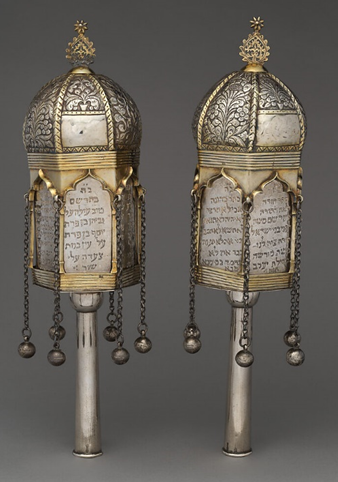
THE RIMONIM, PART II: Last month I reported on the two ornate eighteenth century silver Torah finials called Rimonim that had been at the center of a dispute between Congregation Shearith Israel in New York and Touro Synagogue in Newport, Rhode Island. I mentioned that they had been on loan to the Boston Museum of Fine Arts, and illustrated the posting with a generic image of Rimonim. Then I learned, through emails from attentive newsletter subscribers, that the finials are still on display at FMA, and that the Museum’s website includes a photo (below) of them, along with excellent interpretation, which provides more details about the unique—and valuable—objects. 


The Rimonims’ finial bells make “festive sounds when they are carried around the synagogue,” the museum notes. “Their Hebrew name ‘Rimonim’ means pomegranates, because of the round shape recalling the biblical symbolic fruit.

“This splendid pair, on loan from Congregation Shearith Israel in New York (est. 1654), is an exceptionally rare example of colonial American Judaica. They were made by Myer Myers, a Jewish silversmith who led the market in 18th-century New York.” Myers “produced luxury silverware for both domestic and religious use for [his] Jewish and non-Jewish clients.

“These finials hold a very special place in Jewish American history…. They were … probably in the Newport synagogue during George Washington’s famous visit on August 18th, 1790. Today the New York congregation uses the beautiful Rimonim during the High Holidays.” 

The U.S.S. LEVY: As I reported in Saving Monticello, the first time the United States Navy honored Uriah Levy’s exceptional 50-year naval career came during World War II when a destroyer escort was christened the USS Levy.

That ship, one of the first of its kind in the Navy, served in the southern and central Pacific from August 1943 through the end of the war two years later, seeing action in many engagements, including the two-month Battle of the Philippine Sea in the summer of 1944. 

In August and September 1945 the ship’s officers took part in surrender ceremonies of the Japanese Navy in the southeastern Marshall Islands. They negotiated and accepted the surrender of Mille (sometimes spelled Mili) Atoll on August 21 and witnessed the surrender of Jaluit Atoll later that month. On September 4, the Japanese officially surrendered Wake Island to Marine Corps Brig. Gen. Lawson. H. M. Sanderson aboard the Levy.

Not long after Saving Monticello came out in November 2001, my friend Julie Coles told me that her late father, Daniel F. Evans, had served as a 22-year-old gunnery officer on the ship during the war. And that he took part in the surrender ceremonies. Then, just last week, she sent me the image at left that her father kept in his scrapbook. 

That’s Daniel Evans with the binoculars around his neck, saluting one of the three Japanese officers who came on board on August 21, most likely Navy Capt. Masanori Shigaone 

Julie told me that her father said that he and Lt. Cmdr. William Clarenback (to Evans’ left) were chosen to greet the Japanese officers because they were tall men and their commanding officer Capt. Harold B. Grow wanted them there to tower over and humiliate the Japanese. 

She also said her father told her that after the picture was taken the officer committed ritual suicide. 

You can find more info on the U.S.S. Levy during World War II on two excellent, well-illustrated web sites:  https://bit.ly/USSLevy and https://bit.ly/4USSLevyPhotos  

THE DOC: Steven Pressman’s great documentary, “The Levys of Monticello,” which was inspired by Saving Monticello, continues to appear at film festivals across the country. 

On Wednesday, April 19, there’ll be an in-person screening at the Center for Jewish History at the American Jewish Historical Society in New York City. For details, go to: https://bit.ly/AJHSLevys 

We had a screening on March 14 at The Hill School in Middleburg, Virginia, where I live, sponsored by our town’s library friends group, the Middleburg Library Advisory Board. It was a great event, after which I took questions from the audience and then signed copies of the book at the best book-signing table I’ve ever had, which was set up by a local shop, Crème de la Crème. Yes, that’s a lamp, a potted plant, and two table cloths adorning the table.

EVENTS: Here are details about my four events in April:

·        Sunday, April 2, talk on Saving Monticello, and book signing at Congregation Beth Am Israel in Penn’s Landing, Pennsylvania.   

·        Tuesday, April 11, talk for the Sons of Confederate Veterans Camp, in Winchester, Virginia, on my only Civil War book, Desperate Engagement

·        Saturday, April 15, talk at historic City Tavern in Washington, D.C. on the life of Francis Scott Key, sponsored by the City Tavern Preservation Foundation. This is a free event and is open to the public, with registration required through Eventbrite at https://www.eventbrite.com/e/551699807977 

·        Sunday, April 16, talk on Desperate Engagement for the Washington, D.C., chapter of the Daughters of the Union Veterans of the Civil War

If you’d like to arrange an event for Saving Monticello or for any of my other books, email me at marcleepson@gmail.com For details on other upcoming events, check the Events page on my website:  https://bit.ly/NewAppearances

GIFT IDEAS:  For a personally autographed, brand-new paperback copy of Saving Monticello, please e-mail marcleepson@gmail.com  I also have a few as-new, unopened hardcover copies, along with a good selection of new copies of my other books: Flag: An American Biography; Desperate Engagement; What So Proudly We Hailed; Flag: An American Biography; and Ballad of the Green Beret: The Life and Wars of Staff Sgt. Barry Sadler.


Thursday, March 9, 2023

March 2023


Saving Monticello: The Newsletter

The latest about the book, author events, and more

Newsletter Editor - Marc Leepson


Volume XX, Number 3                                                          March 2023

“The study of the past is a constantly evolving, never-ending journey of discovery.” – Eric Foner


 SHEARITH ISRAEL V. TOURO: 

Here’s a quick, two-part Jewish-American History quiz that has connections to the Levy and Nunez families: Name the oldest Jewish Congregation in the United States and the oldest synagogue in the country. Hint: They are two different entities.

If you said Shearith Israel in New York City and Touro Synagogue in Newport, Rhode Island, you are correct. Congregation Shearith Israel has the distinction of being the first Jewish Congregation in the nation, having been founded in 1654 by Sephardic Jews who had immigrated to Nieuw Amsterdam, as the city was then known, from Brazil.

Touro Synagogue, formally known as Jeshuat Israel, is the second oldest congregation, having been founded a few years later, also by Sephardic Jews. But it holds the honor of being the oldest American synagogue, as its current building was erected 1763.

Shearith Israel’s massive Beaux Arts building on Central Park West (the Congregation’s fourth, in photo below) is a relative newcomer, having been completed in 1897. 


Members of the Nunez and Levy families have been associated with Shearith Israel since around 1735 when Uriah Levy’s great grandmother Maria Caetana Nunez (known as Zipporah), and her husband, David Mendes Machado, moved to New York from Savannah, Georgia, when he was appointed hazzan at Shearith Israel. 

Fast forwarding to the late 19th century, Louis Napoleon Levy—Jefferson Levy’s brother, fellow attorney, and real estate business partner—served as the president of Shearith Israel for many years beginning in 1895.* 

Which brings us to something I just learned: the longtime and not always harmonious relationship between Shearith Israel and Touro, and L. Napoleon Levy’s role in the late 1890s and early 1900s dispute between the two congregations that had its roots in the mid-18th century—and ramifications that continued until 2019. 

It’s a very long and complicated story, spelled out in legal documents that run to hundreds of pages. What follows is a short summary of the dispute, which centered on which party owned the physical Touro building and religious ornaments housed there. 

The ownership question hinged on the fact that in the mid-1700s religious institutions in Rhode Island could not incorporate or own land. So when a group of Jews in Newport raised the funds to buy land for its synagogue—including money donated by Shearith Israel—three community leaders were chosen to serve as trustees for the building and land: Jacob Rodrigues Rivera, Moses Levy, and Isaac Hart.

Soon after that, around the time the Touro Synagogue was consecrated in 1763, a noted silversmith named Myer Myers made an elaborate pair of silver Rimonim (finials for the synagogue’s Torah) for the congregation. In 1793, after most of Newport’s Jews departed the city during the Revolutionary War, regular services ended; by 1822, there were no Jewish people in the city.

Some of the departed Newport Jews joined Shearith Israel. They brought with them the Rimonim and other religious articles, which were kept at Shearith Israel for safekeeping, with the understanding that they would be returned to Touro once worship services started again. The word “Newport” was engraved on their bases so as not to confuse them with a similar pair owned by Shearith Israel.

During the time that Touro (below) was inoperative Shearith Israel helped take care of the synagogue, including holding the building’s keys and making it available for occasional funerals, high holiday services, and special occasions. During that time period, too, Shearith Israel became the official trustee for Touro—although as with the case of the original and subsequent trustees, Shearith Israel never owned the building or the Rimonim.


In the 1870s Jews began returning to Newport and religious services began again at Touro. The new rabbi, Abraham Pereira Mendes of London (in photo below), was chosen by Shearith Israel, in its role as Touro’s trustee. In 1894, the Rhode Island Legislature granted articles of incorporation to the newly named Jeshuat Israel congregation which to this day worships at Touro Synagogue.

Shearith Israel returned the Rimonim to Jeshuat Israel in the late 1800s or early 1900s. During that time, though, a series of legal battles took place between Shearith Israel and Touro over the former’s concern that Newport synagogue was moving away from Sephardic forms of worship. To make matters more complicated, in March 1899 Touro’s congregants split into two groups, both claiming control of the synagogue. Following several lawsuits, the synagogue temporarily closed.


One group, calling itself “Touro Congregation,” tried to hold services in the building, but was forcibly removed. There was a brief reconciliation, but on January 1, 1901, Shearith Israel and like-minded Touro congregants closed the synagogue. A year later, a group made up primarily of members of the self-described Touro Congregation broke into the building to pray and then staged a sit-in. It lasted for a year during which regular religious services were held.

Meanwhile the Newport and New York congregations faced off in the courts. A federal judge ruled in January 1903 for Shearith Israel in a case that was argued by L. Napoleon Levy, the congregation’s president. In David v. Levy Jeshuat Israel, agreed “to admit and recognize without qualification the title and ownership of L. Napoleon Levy and acting trustees [of Shearith Israel] to the synagogue building, premises and fixtures…” 

The court ruling also ordered L. Napoleon Levy and the acting trustees to “make a lease thereof to the Congregation Jeshuat Israel for five years from February 1, 1903, at the nominal rent of one dollar year.” Not long after that ruling Jeshuat Israel chose its first Ashkenazic rabbi, Jacob M. Seidel, while agreeing to conduct services using Sephardic rituals. 

That situation remained in effect—with Jeshuat Israel running Touro Synagogue, Shearith Israel acting as trustee for the building—for more than a century. Then, in 2012, the two congregations once again faced off after the Touro moved to sell some items to raise funds for restoring its building. That included, according to court documents, a $7.4 million offer from the Boston Museum of Fine Arts for the Rimonim. 

On June 29, 2012, Shearith Israel issued a letter demanding that Jeshuat Israel cease and desist from selling the Rimonim, based on the fact that it remained the trustee of the building and its contents. When mediation attempts failed, both sides were to trial in 2015. The case is officially called Congregation Jeshuat Israel v. Congregation Shearith Israel.

A year after a U.S. District Court Judge ruled in 2016 against Shearith Israel the congregation appealed that order to the U.S. Court of Appeals in Boston, which overturned the decision. Touro appealed that decision to the U.S. Supreme Court, which declined to take up the case on March 18, 2019. And today the Rimonim remain in Touro—and Shearith Israel remains the trustee of Touro Synagogue.

At least that’s how I read it. You can read the detailed history of the entire matter—up to the 2016 ruling—on line at https://bit.ly/TourovShearith 

************************

 *As for L. Napoleon Levy’s presidency of the Shearith Israel Congregation, I mentioned in the January newsletter that he held that office from 1895-1896. That was not correct. In fact, L. N. Levy was president of Shearith Israel for much longer. How much longer I am still trying to find out, but I have found primary source materials showing that he was president in the following years: 1897, 1908, 1910, 1919, 1920, and 1921 and very likely in the years in between. L.N. Levy died at age 66 on April 9, 1921.

THE DOC: Steven Pressman’s great documentary, “The Levys of Monticello,” continues to appear at film festivals across the country. Here are details on three upcoming screenings:

 On Sunday, March 13, it will be shown at the St. Louis Jewish Community Center as part of the 28th annual St. Louis Jewish Film Festival. Details: https://bit.ly/StLouisJFF

On Wednesday, March 22, it will be part of the New Hampshire Jewish Film festival with a in-theater screen. Steve Pressman will take part in a Q&A following the screening. Details: https://tinyurl.com/47sydvf3

On Wednesday, April 19, There’ll be an in person screening at the Center for Jewish History at the American Jewish Historical Society in New York City. Details: https://bit.ly/AJHSLevys

 EVENTS: The highlight of my March is a Q&A I will be doing on Tuesday, March 14, at the Hill School auditorium in Middleburg, Virginia, following a screening of “The Levys of Monticello.” The event, sponsored by the Middleburg Library Advisory Board (the Library's Friends group) begins at 6:00 p.m. Details: https://bit.ly/ScreeningMB

 
If you’d like to arrange an event for Saving Monticello or for any of my other books, email me at marcleepson@gmail.com For details on other upcoming events, check the Events page on my website:  https://bit.ly/NewAppearances

GIFT IDEAS:  For a personally autographed, brand-new paperback copy of Saving Monticello, please e-mail marcleepson@gmail.com  I also have a few as-new, unopened hardcover copies, along with a good selection of new copies of my other books: Flag: An American Biography; Desperate Engagement; What So Proudly We Hailed; Flag: An American Biography; and Ballad of the Green Beret: The Life and Wars of Staff Sgt. Barry Sadler.

Sunday, February 5, 2023

February 2023


Saving Monticello: The Newsletter

The latest about the book, author events, and more

Newsletter Editor - Marc Leepson


Volume XX, Number 2                                                          February 2023

“The study of the past is a constantly evolving, never-ending journey of discovery.” – Eric Foner


ANATOMY OF A PHOTOGRAPH: In early 1917, the bitterly contentious effort to take Monticello from Jefferson Levy and turn it into a government-run presidential house museum was entering its fifth year. The first congressional hearings on the idea had taken place in the summer of 1912, a fiery spectacle as Maud Littleton, a Long Island, New York, socialite, and her allies battled it out with Jefferson Monroe Levy over his ownership of Thomas Jefferson’s Essay in Architecture. 

For more than two years, Jefferson Levy had vowed he would not let Monticello go. Why should he? It had been in his family since his uncle Uriah Phillips Levy purchased it in 1834; he and his uncle saved it from ruin twice; and he had not the slightest inclination to sell. 

“When the White House is for sale, then I will consider an offer for the sale of Monticello, and not before,” he said soon after Mrs. Littleton (as she was known in the press) began her single-minded campaign to wrest Monticello from “outsiders,” as her literature put it.

Then, in the fall of 1914, Jefferson Levy, a well-heeled real estate and stock speculator, made a shocking announcement: After a plea from President Woodrow Wilson, Levy said he would sell Monticello—for $500,000. That number, he said, was about a third of what he had spent in the previous 35 years repairing, restoring, running, and persevering the house and grounds—as well as adding significant acreage to the property and lavishly furnishing every room in the mansion. 


As I wrote in Saving Monticello, on January 9, 1917—while Europe was stalemated in the third bloody year of what would become known as World War I—yet another congressional hearing convened to debate Monticello’s fate. This time the Senate Committee on Public Buildings and Grounds met to discuss a resolution that called for the government to purchase Monticello for Levy’s asking price and use it as a Virginia getaway for U.S. presidents, what Camp David in Maryland is today.   

In the weeks following that hearing there still seemed to be fairly widespread sentiment in Congress for the government purchase of Monticello. In an effort to keep the momentum for a sale alive, Daisy Allen Story the Present General of the Daughters of the American Revolution—which had volunteered to run the house museum—arranged for a large group of congressmen to make a personal inspection of Monticello. 

On Sunday morning, January 28, 1917, a party of 40 men and 27 women—including many members of the House Committee on Public Buildings and Grounds and their wives—boarded two chartered Southern Railway cars for the trip to Charlottesville. The train arrived shortly after noon. 

The party—which also included Daisy Story (in photo, below) and members of the DAR’s national Board of Directors—was met at the train station by a delegation from the local Chamber of Commerce and whisked up to snow-covered Monticello in two dozen automobiles. The lead vehicle was decorated with two huge American flags donated by the DAR. 

The group gathered on Monticello’s East Lawn to take in the mountain views and then proceeded to the East Front steps where Jefferson M. Levy greeted them. The guests took a guided tour of all of Monticello’s rooms before sitting down to a lavish lunch in the dining room. Levy brought in a phalanx of Black waiters and maids for the occasion. 

“The spread set out by the genial host of today was in keeping with the traditional hospitality of the famous mansion,” the Charlottesville Daily Progress reported. “An elegant menu was served the many guests, whose appetites had been whetted by the three-mile drive in the bracing mountain air, and they did full justice to the elegant and toothsome viands which had been provided.” Several newspaper and newsreel photographers were on hand, although the images they took have not survived.   

Until now, that is. Bill Bergen, a former long-time Monticello guide and one of the most knowledgeable Monticello historians I know, has unearthed a striking photo that almost certainly portrays the group posing on the East Front steps. Bill filled me in on the detective work he performed to identify the photo. 


More than a few years ago, Bill said, he had scanned the image, which he found in the Thomas Jefferson Foundation photo files in the Jefferson Library.” The image was simply labeled “unidentified group.” 

Then, a couple of weeks ago, Bill immediately thought of that undated and unidentified group photo after reading a Facebook post by the Richmond (Va.) journalist Coy Barefoot. In it, he posted several articles from the January 29, 1959, Charlottesville Daily Progress, one of which looked back on that date in local history an item for the newspaper’s January 29, 1917 edition.

To wit: “A delegation of about 70 from the Committee on Public Buildings and Grounds of the House of Representatives inspected Monticello yesterday in connection with the proposed purchase of Jefferson's home by the national government.” 

“I had forgotten about the visit,” Bill told me, “and it occurred to me the mystery photograph might depict that occasion.” His first step was to go to Saving Monticello where he found the passage that I paraphrased above with the details of the January 29, 1917, congressional visit. Next, Bill unearthed a list of the committee’s 1917 members, as well as images of nearly all 21 of them. “By comparing those online images with the men in the attached picture,” he said, “I identified 12 people whose visages seem to match.” 

More evidence pointing to this being the 1917 images, Bill said, was the fact that everyone in it is wearing winter clothing, as well as “the presence of women [presumably spouses and DAR members], two individuals in uniform (the U.S. had not yet declared war, but National Guard units were expanding at that time), and the general fashions depicted, which suggest a date somewhere close to the U.S. entry into World War I.” 

What’s more, he said, other images of the Entrance Hall taken early in early 1917 show the windows adorned with curtains, as the photograph in question does. And photographs depicting the same Entrance Hall in the early 1920s after the Thomas Jefferson Foundation purchased Monticello from Jefferson Levy “show the same windows without curtains,” which “supports the idea that the congressional delegation photo was not taken during the Foundation’s ownership.” 

As for the nine men aside from the committee members in the images, they most likely were “hangers-on, aides, or, quite likely, other politicians, including members of the Virginia congressional delegation. Fewer than the 70 or so people mentioned [in the newspaper article] are in the photograph, so not everyone who made the trip posed for the photographer.” 

After a closer look, Bill and I believe we recognized one of the non-committee members in the photo. The bald-headed man with the bushy white moustache wear the fur-collared jacket in the third row from the bottom just to the right of the man with the full beard very likely is Judge R.T.W. “Tom” Duke Jr., Jefferson Levy’s Charlottesville lawyer (in right photo). Alas, Jefferson Levy—not exactly a camera-shy man—does not appear in the photo. 

I am thankful to my friend Bill Bergen for some great historical sleuthing and for sharing it with me. When he suggested that I might want to report on it in the newsletter, I replied, “Let me think about it for a minute—Yes!” 

*********************** 

By the way, that congressional visit was not exactly a success. The problem—of all things—was Jefferson Levy’s refusal to serve wine with lunch. When the thirsty congressmen and company asked Levy to show them Jefferson’s wine cellar, he responded, according to a Roanoke Times article I dug up, that “he had left the keys in New York.” 

“‘Well, that’s all right,’ said some of the leading committee members. ‘We’ll just break in the door and make a hole in the floor.’ 

“But Levy said, ‘No’ and would not budge from the decision.” 

That brought about “much grumbling” from the distinguished guests, the newspaper said, “and it was freely rumored that Mr. Levy would have to materially reduce his offer [to sell Monticello to the government] below $500,000 if he expected Congress to buy the old Jefferson home.” 

Whether or not that last line was sarcastic, and whether the lack of wine accompanying that meal had any impact on the congressmen, the fact remains that the 64th Congress adjourned on March 3, 1917, without taking any action on any of the Monticello resolutions. 

And when the U.S entered the Great War the next month the matter was dropped. 

THE DAVID STATUE: As we noted in the October and November 2021 issues of the newsletter, the New York City Council decided two years ago that it no longer wanted the larger-than-life statue of Thomas Jefferson that had been in its chambers since it was donated to the city by Uriah Levy in 1834. The statue—to be more precise, the plaster model of said statue commissioned by Levy from the great French sculptor David d’Angers, the original of which is in the U.S. Capitol Rotunda—was then moved to the lobby of the New-York Historical Society building on Central Park West at 77th Street. 


My friend and colleague Steve Pressman, the writer and director of “The Levys of Monticello,” paid a visit to the museum last month, and kindly sent me the photo (right) and the following on-the-spot report: 

I was in New York City to see some art exhibitions and dropped by the New-York Historical Society to take in a fun exhibit about Jewish delis—alas, a vanishing breed both in NYC and the rest of the country. 

Before entering the world of pastrami-on-rye and bagel schmears, I was delighted to come across an instantly recognizable figure right inside the main entrance to the building—a seven-foot statue of Thomas Jefferson, quill pen in hand, gazing earnestly at the passersby. 

On the day of my visit to the Historical Society, most of the other visitors brushed right by the Jefferson statue, apparently far more eager to pay their respects to the memories of the Carnegie and Stage Delis, both of which, sadly, are no longer with us. 

But I chose instead to linger, at least for a few moments, out of respect for both Thomas Jefferson and Uriah Phillips Levy. Both men, to be sure, owned enslaved people—and I’m mindful of their moral contradictions that we continue to grapple with centuries later. Still, I was happy to see the d’Angers statue at its new home in New York City—with or without half-sour pickles. 

THE DOC: Steve’s great documentary, “The Levys of Monticello,” continues to appear at film festivals across the country. On Wednesday, February 8, at 7:00 p.m. it will be screened at the Charlotte (North Carolina) Jewish Film festival at that city’s Temple Israel. For more info, go to https://bit.ly/CharlotteLevys 

On Wednesday, February 15, the film will be shown as part of the 33rd Annual Orange County International Jewish Film Festival in Southern California. Info at: https://bit.ly/OrangeCoFestival 

And on Sunday, February 26, I’ll be taking part in a post-screening Q&A at the Samuel C. Johnson Theater at Norfolk Academy in Norfolk, Virginia, as part of the Virginia Festival of Jewish Film. The event begins at 2:30 p.m. More info: https://bit.ly/NorfolkFestival 

FEBRUARY EVENTS: In addition to the event in Norfolk, I’ll be doing a talk on the life of Francis Scott Key, based on my biography What So Proudly We Hailed, on Monday, February 5, via Zoom for the Peter Minuet DAR chapter of New York City.

On Monday, February 20, at 2:00 p.m. I’ll be talking about Saving Monticello via Zoom for the Bender JCC of Greater Washington (D.C.). Steve Pressman will be joining me as we also discuss the making of “The Levys of Monticello.”

If you’d like to arrange an event for Saving Monticello or for any of my other books, email me at marcleepson@gmail.com  For details on other upcoming events, check the Events page on my website: https://bit.ly/NewAppearances


GIFT IDEAS:  For a personally autographed, brand-new paperback copy of Saving Monticello, please e-mail marcleepson@gmail.com  I also have a few as-new, unopened hardcover copies, along with a good selection of new copies of my other books: Flag: An American Biography; Desperate Engagement; What So Proudly We Hailed; Flag: An American Biography; and Ballad of the Green Beret: The Life and Wars of Staff Sgt. Barry Sadler.

The SM Newsletter on Line: You can read back issues of this newsletter at http://bit.ly/SMOnline